Exchange Interaction: Fermions and Bosons
1. Indistinguishability of Identical Particles
In quantum mechanics, identical particles cannot be distinguished from one another, even in principle. If we exchange two identical particles, there is no way—either in theory or in experiment—to tell that anything has changed. This simple idea has deep implications for how we describe many-particle systems.
1.1 Product States and Indistinguishability
Suppose particle 1 (with coordinate \(\vec{r}_1\)) is in state \(\psi_a\),
and particle 2 (with coordinate \(\vec{r}_2\)) is in state \(\psi_b\).
If we ignore spin for now, a naive approach would be to write the total wavefunction as a product of single-particle wavefunctions:
\[ \Psi(\vec{r}_1, \vec{r}_2) = \psi_a(\vec{r}_1)\, \psi_b(\vec{r}_2). \]
Note of caution:
In general, two-particle states cannot always be written as simple products.
Such product states are only a useful starting point for understanding the basic symmetry properties.
This expression assumes we can tell which particle is “particle 1” and which is “particle 2.” That assumption is fine in classical mechanics, where particles follow well-defined trajectories. But in quantum mechanics, identical particles have no individual identity — exchanging them cannot lead to a physically new state.
1.2 Example: Scattering of Indistinguishable Particles
Imagine two identical particles scattering off each other. Classically, there are two possible paths:
- Case 1: particle 1 is deflected to the right, particle 2 to the left
- Case 2: particle 1 is deflected to the left, particle 2 to the right
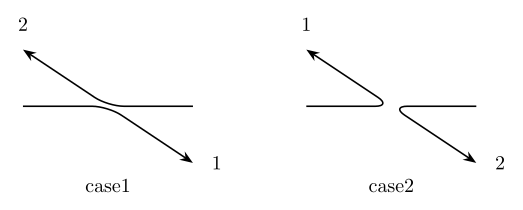
For identical particles in quantum mechanics, these two alternatives are indistinguishable. The total probability amplitude must include both processes at once, and the two amplitudes interfere with each other. This interference is a hallmark of quantum indistinguishability.
2. Exchange
In quantum mechanics, if we exchange two identical particles, the system must end up in the same physical state. However, the wavefunction itself may change by a phase factor.
Mathematically, this is captured by introducing an operator that performs the exchange explicitly.
2.1 The Exchange Operator
We define the permutation (or exchange) operator \(P_{12}\), which swaps the coordinates of the two particles:
\[ P_{12}\,|\vec{r}_1, \vec{r}_2\rangle = |\vec{r}_2, \vec{r}_1\rangle. \]
If the particles have additional quantum numbers (such as spin, magnetic quantum number, etc.), the operator also swaps those quantities.
Because exchanging twice returns the system to its original configuration, the operator satisfies:
\[ P_{12}^2 = \hat{I}. \]
Moreover, since the Hamiltonian \(\hat{H}\) of a system of identical particles does not depend on labeling, the exchange operator commutes with it:
\[ [P_{12}, \hat{H}] = 0. \]
This means that we can find states that are simultaneous eigenstates of both \(\hat{H}\) and \(P_{12}\). The eigenvalues of \(P_{12}\) can only be \(\pm 1\):
\[ P_{12}\Psi(\vec{r}_1, \vec{r}_2) = \begin{cases} +\Psi(\vec{r}_1, \vec{r}_2), & \text{for symmetric wavefunctions}, \\ -\Psi(\vec{r}_1, \vec{r}_2), & \text{for antisymmetric wavefunctions.} \end{cases} \]
These two possibilities correspond to two fundamentally different kinds of particles.
2.2 Symmetrized and Antisymmetrized States
For two identical particles, we cannot meaningfully assign labels “1” and “2.” The wavefunction must reflect this symmetry by being either symmetric or antisymmetric under exchange.
We can construct the two possibilities as follows:
\[ \Psi_+(\vec{r}_1, \vec{r}_2) = A \big[\, \psi_a(\vec{r}_1)\psi_b(\vec{r}_2) + \psi_b(\vec{r}_1)\psi_a(\vec{r}_2) \big], \]
\[ \Psi_-(\vec{r}_1, \vec{r}_2) = A \big[\, \psi_a(\vec{r}_1)\psi_b(\vec{r}_2) - \psi_b(\vec{r}_1)\psi_a(\vec{r}_2) \big], \]
where \(A\) is a normalization constant ensuring that \(\int |\Psi|^2 \, d^3r_1\, d^3r_2 = 1\).
- \(\Psi_+\) is symmetric: exchanging the two particles leaves it unchanged.
- \(\Psi_-\) is antisymmetric: exchanging the two particles changes its sign.
2.3 Spin and Statistics
In non-relativistic quantum mechanics, we take as an axiom the following rule:
- Particles with integer spin are bosons, and their total wavefunction is symmetric under exchange.
- Particles with half-integer spin are fermions, and their total wavefunction is antisymmetric under exchange.
This fundamental connection between spin and exchange symmetry is a consequence of the spin–statistics theorem, a deep result from relativistic quantum field theory. For our purposes, we take it as an experimentally verified fact.
2.4 The Pauli Exclusion Principle
Let’s consider two identical fermions that try to occupy the same one-particle state \(\psi_a\):
\[ \Psi_-(\vec{r}_1, \vec{r}_2) = A\big[\psi_a(\vec{r}_1)\psi_a(\vec{r}_2) - \psi_a(\vec{r}_1)\psi_a(\vec{r}_2)\big] = 0. \]
The antisymmetric wavefunction vanishes identically, meaning that such a configuration is forbidden.
This is the Pauli exclusion principle:
No two fermions can occupy the same quantum state.
This principle explains the structure of the periodic table, the stability of matter, and the behavior of electrons in solids.
3. Generalization Beyond Coordinates
So far, we have discussed the exchange operation in coordinate space, where \(P_{12}\) swaps the position arguments \(\vec{r}_1\) and \(\vec{r}_2\). However, the same idea applies much more generally: a quantum state can be labeled by any set of quantum numbers — such as energy level, orbital angular momentum, spin projection, etc.
In this abstract formulation, the exchange operator acts by swapping the complete sets of quantum numbers associated with the two identical particles:
\[ P_{12}\,|1\rangle_1 |2\rangle_2 = |2\rangle_1 |1\rangle_2, \]
where the numbers in the kets refer to one-particle states (for example, different orbitals), and the subscripts denote which particle is in that state.
The physical requirement is exactly the same as before: exchanging two identical particles must not produce a new physical situation. Therefore, the total two-particle state must either remain unchanged or change sign under this operation, corresponding to bosons and fermions, respectively.
In other words, the coordinate-space wavefunctions \(\Psi(\vec{r}_1, \vec{r}_2)\) are just one particular representation of this more general principle.
4. Summary
| Property | Bosons | Fermions |
|---|---|---|
| Spin | integer | half-integer |
| Wavefunction symmetry | symmetric | antisymmetric |
| Exchange eigenvalue | \(+1\) | \(-1\) |
| Occupation rule | multiple particles per state | at most one per state |
| Example | photons, helium-4 atoms | electrons, protons, neutrons |
Remark:
The “exchange interaction” is not a new force in the classical sense. It arises purely from the requirement that the total wavefunction be symmetric (for bosons) or antisymmetric (for fermions). Nevertheless, this quantum exchange effect leads to observable consequences — such as the splitting of energy levels in helium, magnetic ordering in solids, and the formation of energy bands in metals and semiconductors.