Having established how molecular energy levels arise from electronic, vibrational, and rotational degrees of freedom, we now turn to how these quantized states interact with electromagnetic radiation. Absorption or emission of photons allows molecules to transition between these energy levels, providing a direct window into molecular structure, bonding, and dynamics.
While electronic transitions probe the fast motion of electrons, vibrational and rotational transitions probe the slower motion of nuclei. For diatomic molecules, this separation of timescales makes the system especially transparent: nuclear motion reduces to a single internuclear coordinate\(R\) with associated rotational and vibrational motions superimposed on the electronic structure.
Within this framework, molecular spectroscopy becomes the study of transition rates and selection rules governing the allowed changes in vibrational, rotational, and electronic states. Infrared (IR) spectroscopy detects transitions due to changes in a molecule’s permanent dipole moment, whereas Raman spectroscopy probes changes in the molecular polarizability. Together, these complementary techniques provide a comprehensive picture of molecular vibrations and rotations, even for molecules with high symmetry or no permanent dipole moment.
Goals of this Chapter
By the end of this chapter, you should be able to:
Explain how molecular transitions arise from the interaction of molecules with electromagnetic radiation.
Derive the transition dipole moment and understand its decomposition into electronic and nuclear contributions.
Apply selection rules to predict allowed vibrational, rotational, and electronic transitions.
Describe the structure of rovibrational spectra, including P- and R-branches.
Distinguish between IR and Raman spectroscopy, and understand the role of permanent dipoles and polarizability.
Appreciate the practical relevance of rovibrational transitions, from molecular identification to environmental phenomena like the greenhouse effect.
This chapter provides the quantitative and qualitative tools needed to interpret molecular spectra and connect them to underlying quantum mechanical motion.
1. Transition Rates and Selection Rules
The interaction of a molecule with electromagnetic radiation allows it to change energy states, with the rate of these transitions governed by quantum mechanics. For a molecule initially in state \(| \Psi_i \rangle\) and finally in state \(| \Psi_k \rangle\), the transition probability is determined by the electric dipole operator\(\hat{\vec \mu}\):
This transition dipole matrix element encapsulates the likelihood of the transition: if \(M_{ik}=0\), the transition is forbidden; if \(M_{ik}\neq0\), the transition is allowed and its intensity depends on \(|M_{ik}|^2\).
The spontaneous emission rate is then given by the Einstein coefficient:
where \(\omega_{ik} = (E_k - E_i)/\hbar\) is the transition frequency. In the following sections, we will decompose the transition dipole into electronic and nuclear contributions, and explore how selection rules arise for electronic, vibrational, and rotational transitions.
1.1 Complete decomposition of the transition dipole
The fundamental quantity that controls spectroscopic intensity is the transition dipole moment \(M_{ik}=\langle\Psi_k|\hat{\vec\mu}|\Psi_i\rangle\), with the total dipole operator \[
\hat{\vec\mu} \;=\; -e\sum_{\text{electrons}} \vec r_i \;+\; e\sum_{\text{nuclei}} Z_A \vec R_A
\;=\;\hat{\vec\mu}_{\rm el} + \hat{\vec\mu}_N.
\]
Within the Born–Oppenheimer approximation, the total molecular wavefunction can be written as \(\Psi(\mathbf r, {\mathbf R}) = \Phi(\mathbf r; {\mathbf R}),\chi({\mathbf R})\), where \(\mathbf r\) denotes all electronic coordinates \(\vec r_i\) and \(\mathbf R\) all nuclear positions \({\vec R_A}\). For a diatomic molecule, the nuclear geometry is determined by a single vector \(\vec R = \vec R_2 - \vec R_1\) (or equivalently its length \(R\)), so the wavefunction simplifies to \(\Psi(\mathbf r, R) = \Phi(\mathbf r; R),\chi(R)\). Using this ansatz, the matrix element separates into an inner electronic integral and an outer nuclear integral. For a transition between two states that (possibly) differ in electronic, vibrational and rotational quantum numbers one obtains the standard decomposition:
Two remarks:
- \(\langle\cdots\rangle_{\mathbf r}\) means integrate over electronic coordinates only (parametric dependence on \(R\) remains).
- The first term is the electronic contribution weighted by nuclear overlap; the second involves the nuclear dipole operator and overlaps of electronic states (often zero unless the electronic states are the same).
Note: If the coordinate origin is placed at the center of nuclear charge, the expectation value of the nuclear dipole vanishes for the equilibrium geometry. For this reason, the nuclear term is often omitted in textbooks, though it is implicitly included through the choice of coordinates.
1.2 Useful limits and how they produce observed spectra
From the single formula above one obtains the familiar spectroscopic cases by taking the appropriate limits.
(A) Electronic transitions (\(i\) and \(k\) different electronic states)
The dominant contribution arises from the first term, where \(\rho_{ik}(R)\neq 0\). The outer integral
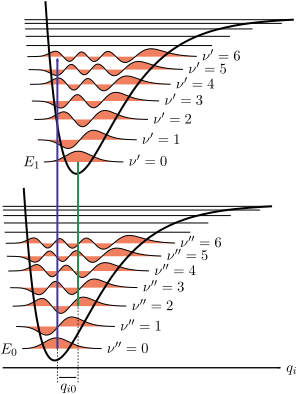
represents the electronic transition dipole moment averaged over the vibrational wavefunctions of the two electronic states. The resulting overlap integrals determine the Franck–Condon factors, which govern the relative intensities of vibronic transitions.
These factors express the Franck–Condon principle: because electronic motion is much faster than nuclear motion, electronic transitions occur essentially at fixed internuclear distance. As a result, the most intense transitions connect vibrational levels whose wavefunctions overlap most strongly at the same nuclear geometry.
Figure 1: Franck–Condon diagram illustrating electronic transitions between two potential energy curves of a diatomic molecule. Vertical arrows indicate the most probable transitions corresponding to the Franck–Condon principle. (Image credit: Samoza, CC BY-SA 3.0, source file)
NoteSelection Rules for Electronic Transitions
Electric dipole–allowed electronic transitions in diatomic molecules must satisfy:
Spin multiplicity:\(\Delta S = 0\)
Orbital angular momentum projection:\(\Delta \Lambda = 0, \pm 1\)
(Transitions such as \(\Sigma \leftrightarrow \Sigma\), \(\Sigma \leftrightarrow \Pi\), or \(\Pi \leftrightarrow \Delta\) are allowed.)
The \(\Sigma \leftrightarrow \Sigma\) case is forbidden if both states have the same overall parity.
Total angular momentum (including rotation): \(\Delta J_{\text{tot}} = 0, \pm 1\) (with \(J_{\text{tot}} = 0 \leftrightarrow 0\) forbidden), where \(J_{\text{tot}} = J + \Omega\) and \(J\) denotes the rotational quantum number of the nuclei.
Inversion symmetry (for homonuclear molecules):
Electric dipole transitions must change parity: \(g \leftrightarrow u\) allowed; \(g \leftrightarrow g\) and \(u \leftrightarrow u\) forbidden.
Examples
N\(_2\): X\(^1\Sigma_g^+ \!\to\) B\(^3\Pi_g\) → forbidden (both \(g \to g\) and \(\Delta S \neq 0\))
Here, \(\hat z_{\rm mol}\) denotes the unit vector along the molecular axis, and \(\mu(R)\) is the signed projection of the permanent dipole moment onto this axis (it can be positive or negative depending on which atom carries the partial negative charge).
Using the separation \(\chi(R,\Omega) = \dfrac{u_v(R)}{R} Y_{JM}(\Omega)\) and noting that the dipole vector lies along the molecular axis, the matrix element factors into a radial (vibrational) and an angular (rotational) part:
The angular factor arises because \(\hat z_{\rm mol} \cdot \hat z_{\rm space} = \cos\theta\). It is important to retain the sign of \(\mu(R)\), as it determines the direction of the permanent dipole and thus affects interference and transition intensities. For homonuclear diatomics, \(\mu(R) \equiv 0\) by symmetry, so electric-dipole vibrational transitions are forbidden.
Remark:
In electronic structure calculations, \(\mu(R)\) can be obtained as the expectation value \[
\mu(R) = \int \Phi_0^*(\vec r;R)\, \hat{\vec \mu}\!\cdot\!\hat z_{\rm mol}\, \Phi_0(\vec r;R)\, d^3r.
\] The sign of \(\mu(R)\) depends on the chosen coordinate origin and molecular orientation; using the center of nuclear charge as the origin provides a consistent convention.
Consequences:
The radial integral determines the vibrational selection rules.
Expanding \(\mu(R)\) around the equilibrium distance \(R_e\), \[
\mu(R)\approx \mu_e + \mu'_e (R-R_e)+\tfrac12\mu''_e(R-R_e)^2+\cdots,
\] the leading linear term \(\mu'_e(R-R_e)\) couples harmonic oscillator levels with \(\Delta v=\pm1\) (the fundamental). Higher derivatives allow weaker overtones\(\Delta v=\pm2,\pm3,\dots\).
The angular integral determines the rotational selection rules. Since \(\cos\theta\propto Y_{1,0}\), the integral is nonzero only for \(\Delta J=0,\pm1\). For \(\Sigma\) electronic states, parity forbids \(\Delta J=0\), leaving \(\Delta J=\pm1\).
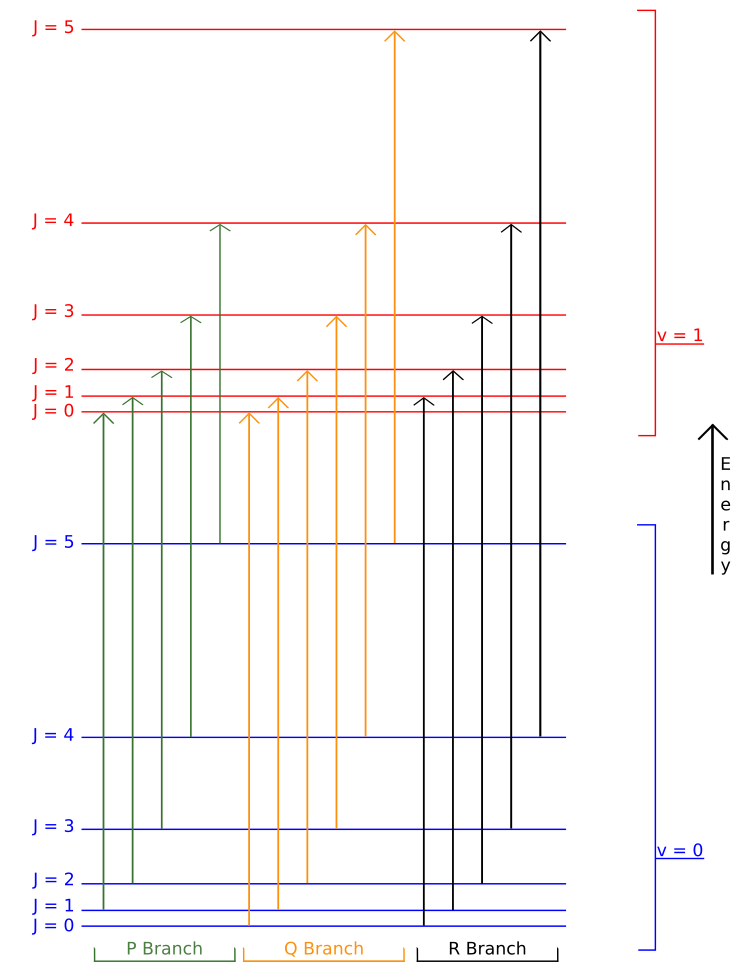
Thus rovibrational spectra display two branches: P (\(\Delta J=-1\)) and R (\(\Delta J=+1\)).
Figure 2: Rovibrational energy levels of a diatomic molecule showing vibrational ladders with rotational substructure. Transitions with \(\Delta v=\pm1\) and \(\Delta J=\pm1\) form the characteristic P and R branches. (Image: David-i98, Public domain, source file)
NoteDipole Selection Rules for Vibrational and Rotational Transitions
For electric dipole transitions in diatomic molecules:
Vibrational:\(\Delta v = \pm 1\) (fundamental), weaker overtones with \(\Delta v = \pm 2, \pm 3, \dots\)
Rotational:\(\Delta J = \pm 1\) (P and R branches)
Parity constraint:\(\Delta J = 0\) forbidden for \(\Sigma\) states
Molecular symmetry: Transitions require a permanent dipole moment — homonuclear diatomics (H₂, N₂, O₂) are infrared-inactive.
(C) Pure rotational transitions (microwave region)
Take the same electronic and vibrational levels (\(v'=v\)) so the radial factor becomes approximately the permanent dipole evaluated at the vibrational state:
Then \[
M_{J'\!,J}\approx \langle\mu\rangle_v \int Y_{J'M'}^*(\Omega)\cos\theta\,Y_{JM}(\Omega)\,d\Omega,
\] and the angular integral enforces \(\Delta J=\pm1\). This is the origin of pure rotational spectroscopy (observed in the microwave) — it is simply the rovibrational expression collapsed to \(v'=v\).
(D) Homonuclear molecules
For homonuclear diatomics symmetry forces \(\vec\mu(R)\equiv\vec 0\) for all \(R\). Hence the entire family of electric-dipole vibrational/rotational matrix elements vanishes: no IR-active rovibrational transitions. Weak higher-order mechanisms (electric quadrupole, magnetic dipole) may produce extremely weak rotational lines, but those require separate operators and much smaller matrix elements.
1.3 Physical Interpretation
Electronic transitions involve changes in \(\Phi(\vec{r};R)\) and occur in the visible or UV range.
Vibrational and rotational transitions are allowed when the electronic state has a nonzero permanent dipole \(\mu(R)\). The transition probability is determined by the matrix element of \(\hat{\vec \mu}\) between different vibrational and rotational nuclear wavefunctions.
For homonuclear diatomic molecules, symmetry ensures that \(\mu(R) = 0\) for all \(R\), so no infrared transitions occur — there is simply nothing for the electric field to “grab onto.” In contrast, heteronuclear molecules like HCl or CO have nonzero \(\mu(R)\) and therefore display strong rotational and vibrational spectra.
TipRelevance of Rovibrational Transitions for the Greenhouse Effect
Rovibrational transitions of molecules play a key role in the Earth’s greenhouse effect. Molecules absorb infrared (IR) radiation emitted by the Earth’s surface via changes in their vibrational and rotational states, trapping heat in the atmosphere.
CO\(_2\) and other linear molecules: Even though the main CO\(_2\) isotopologues (\(^{12}\)C\(^{16}\)O\(_2\)) are linear and have no permanent dipole moment, some vibrational modes (particularly the asymmetric stretch \(\nu_3\) and bending modes \(\nu_2\)) induce temporary dipole changes as the molecule vibrates. These transient dipoles allow IR absorption, making CO\(_2\) IR-active.
Water (H\(_2\)O): Water is a polar molecule with a permanent dipole, so it absorbs broadly in the IR. However, the atmospheric transmission window around 8–12~µm is relatively transparent to water. CO\(_2\) absorbs in some of these windows, blocking thermal radiation that would otherwise escape.
Abundance matters: CO\(_2\) is the most abundant heteronuclear greenhouse gas in the atmosphere. Combined with its active IR modes, this makes it extremely effective at trapping heat despite its linear, centrosymmetric structure.
Comparison: Molecules like N\(_2\) and O\(_2\), being homonuclear, have no permanent dipole and no IR-active vibrational modes; they are essentially transparent to IR radiation. H\(_2\)O and CO\(_2\) dominate IR absorption due to their dipole behavior, though H\(_2\)O has variable concentration and CO\(_2\) is more uniformly mixed.
Summary: The ability of CO\(_2\) and other heteronuclear molecules to absorb IR radiation through rovibrational transitions underlies the greenhouse effect. This absorption is critically dependent on transient dipoles induced by molecular vibrations, even for molecules that are globally nonpolar.
2. Rovibrational Spectroscopy
As discussed in Section 4.3, the total energy of a diatomic molecule in its ground electronic state can be written approximately as
where
- \(v\) is the vibrational quantum number,
- \(J\) is the rotational quantum number,
- \(B_v\) is the rotational constant for vibrational level \(v\),
- \(\chi_e\) accounts for anharmonicity,
- and \(D_J\) describes centrifugal distortion (bond stretching at high \(J\)).
2.1 Rovibrational Spectrum Structure
A typical infrared absorption spectrum of a diatomic molecule shows a characteristic band structure consisting of:
P-branch (\(\Delta J = -1\)): Lines at frequencies lower than the band center
Band center (gap): Corresponds to the pure vibrational transition (forbidden for \(\Sigma\) states)
R-branch (\(\Delta J = +1\)): Lines at frequencies higher than the band center
Code
import numpy as npimport matplotlib.pyplot as pltfrom scipy.interpolate import interp1dplt.rcParams['text.usetex'] =Trueplt.rcParams['font.family'] ='serif'plt.rcParams['font.size'] =15# --- Load benchmark data ---def load_curve(filename):# Allow any whitespace as separator data = np.loadtxt(filename, delimiter=',', comments='#')# Handle possible extra columns (some files have >2) E = data[:, 0] I = data[:, 1]return E, I# Example: you must supply these filesE, I = load_curve('./HCl.csv')# --- Plotting ---fig, ax = plt.subplots(figsize=(7,5))ax.plot(E, np.maximum(I-0.07,0), label=r'spectrum', color='b', lw=0.5)ax.set_xlabel(r'Wave number (cm$^{-1}$)')ax.set_ylabel(r'Absorbance')ax.text(2800, 10.5, r'$P$-branch', ha='center', va='center', fontsize=15)ax.text(2950, 10.5, r'$R$-branch', ha='center', va='center', fontsize=15)ax.set_yticks([])#ax.set_xlim([0, 2.5])ax.set_ylim([0, 11.5])plt.tight_layout()plt.show()
FTIR spectrum of HCl showing P-branch and R-branch.
Analysis of Line Positions
For a transition \(v_i \to v_k\) with simultaneous rotational transition \(J_i \to J_k\), the photon energy is:
\[h\nu = E(v_k, J_k) - E(v_i, J_i)\]
For the fundamental vibrational transition (\(v = 0 \to v = 1\)) in the ground electronic state:
where:
- \(\nu_0 = \omega_e(1 - 2\chi_e)\) is the band origin (pure vibrational frequency)
- \(B_0\) and \(B_1\) are the rotational constants for \(v = 0\) and \(v = 1\), respectively
- \(J\) denotes the initial rotational quantum number \(J_i\)
Key Spectroscopic Features
From the HCl spectrum, we can observe:
Line spacing: The spacing between adjacent lines in each branch is approximately \(2B\) (the rotational constant)
Band center gap: No transition appears at \(\nu_0\) due to the \(\Delta J = 0\) selection rule
Asymmetry: The R-branch and P-branch are not perfectly symmetric due to:
Isotope splitting: HCl naturally contains two isotopes (\(^{35}\)Cl and \(^{37}\)Cl in roughly 3:1 ratio). Each line appears as a doublet because:
Different reduced masses: \(\mu_{35} \neq \mu_{37}\)
Different rotational constants: \(B \propto 1/\mu\)
Slightly different vibrational frequencies: \(\omega \propto 1/\sqrt{\mu}\)
Line intensity variation: The intensity of rotational lines depends on:
The Boltzmann population of the initial state: \(\propto (2J+1)e^{-E(J)/k_BT}\)
The transition dipole moment squared: \(|M_{ik}|^2 \propto J\) or \((J+1)\)
This leads to a maximum intensity at intermediate \(J\) values, with intensity falling off at high \(J\) due to decreasing thermal population.
Modern Fourier Transform Infrared (FTIR) spectrometers with resolutions better than 0.1 cm⁻¹ can resolve individual rotational lines, allowing precise determination of these quantities.
3. Raman Spectroscopy
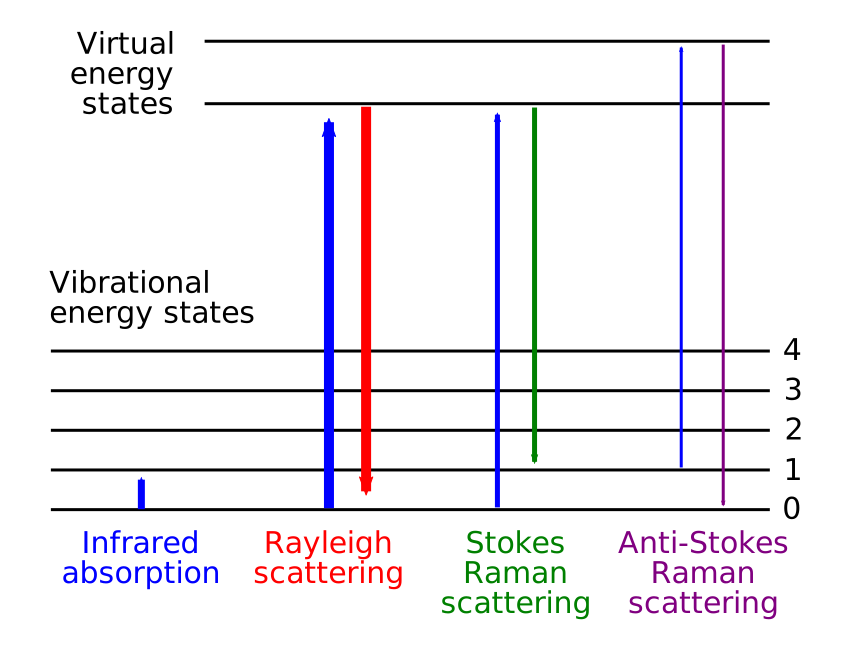
In Raman spectroscopy, molecular transitions are induced not by direct absorption but by inelastic scattering of photons. When a photon interacts with a molecule, it can exchange energy with a vibrational or rotational mode:
Stokes line: scattered photon loses energy (molecule gains vibrational energy)
Anti-Stokes line: scattered photon gains energy (molecule loses vibrational energy)
The selection rule arises from the requirement that the molecular polarizability changes during the nuclear motion:
\[
\Delta \alpha \neq 0
\]
Hence, even molecules without a permanent dipole moment (e.g., N\(_2\), O\(_2\)) can be Raman active.
Figure 3: Raman energy level diagram illustrating Stokes and anti-Stokes scattering. (Image: Dake / Wikimedia Commons, CC BY-SA 3.0, source file)
3.1 IR vs. Raman Activity
Spectroscopy Type
Transition Mechanism
Selection Rule
Example Active Molecules
Infrared (IR)
Interaction with electric field via permanent dipole
Electronic state must have \(\mu(R)\neq 0\); vibrational/rotational motion modulates dipole
HCl, CO
Raman
Interaction with electric field via induced dipole (polarizability)
\(\Delta \alpha \neq 0\)
N\(_2\), O\(_2\), CO\(_2\)
Notes:
In IR spectroscopy, vibrational and rotational transitions within a given electronic state are allowed only if the molecule has a nonzero permanent dipole moment in that state. Homonuclear diatomics (H\(_2\), N\(_2\), O\(_2\)) are inactive.
Raman transitions are complementary: they can occur even if the permanent dipole is zero, provided that the polarizability changes with nuclear motion.
3.2 Polarizability and the Origin of Raman Scattering
In Raman scattering, the electric field of the incident light induces an oscillating dipole moment in the molecule. If the molecule’s polarizability depends on its nuclear configuration, this induced dipole can oscillate not only at the frequency of the incoming light but also at shifted frequencies corresponding to molecular vibrations.
The complex, coupled motion of all atoms in a molecule can be mathematically simplified using normal coordinates (\(Q_k\)). These coordinates represent independent, fundamental vibrational modes where all atoms move in-phase and oscillate at a single, characteristic frequency (\(\omega_k\)).
If we approximate one vibrational mode as
\[
Q_k(t) = Q_{k0} \cos(\omega_k t),
\]
then inserting this into the first-order expansion gives
\(|i\rangle\) and \(|f\rangle\) are the initial and final molecular states (differing in vibrational energy).
\(|m\rangle\) is a virtual electronic state.
\(\vec \mu\) is the dipole operator.
The denominator expresses the off-resonant nature of the process.
In the far off-resonant limit, this second-order interaction effectively reduces to the polarizability tensor\(\alpha_{ij}\), connecting the semi-classical and quantum viewpoints.
Summary:
Raman scattering arises because molecular vibrations modulate the polarizability, allowing the oscillating induced dipole to reradiate light at shifted frequencies. A mode is Raman active if it changes how the molecule’s electron cloud responds to an electric field.
3.3 Relevance of Raman Spectroscopy for Chemistry
Raman spectroscopy is widely used in chemistry for molecular identification, structure determination, and reaction monitoring. It is particularly valuable for symmetric molecules that are IR-inactive but Raman-active, providing complementary vibrational information. Raman can probe bond strengths, molecular symmetry, and phase changes in solids, liquids, and gases.
Key Takeaways
This chapter has introduced the fundamental concepts of molecular transitions and spectroscopy, focusing on rotational, vibrational, and electronic degrees of freedom. The following points summarize the essential ideas:
Molecular transitions are quantized: Molecules can only absorb or emit photons that match the energy difference between discrete quantum states.
Transition dipole moments govern intensity: The electric dipole operator\(\hat{\vec \mu}\) determines which transitions are allowed; the square of the matrix element \(|M_{ik}|^2\) controls the spectral intensity.
Decomposition into electronic and nuclear contributions: Using the Born–Oppenheimer approximation, the transition dipole separates into an electronic integral and a nuclear integral, giving rise to Franck–Condon factors for vibronic transitions.
Selection rules arise from symmetry and angular momentum:
Vibrational transitions: Typically \(\Delta v = \pm1\) (fundamental), with weaker overtones for \(\Delta v = \pm2, \pm3, \dots\)
Rotational transitions:\(\Delta J = \pm1\) (P and R branches); \(\Delta J = 0\) forbidden for \(\Sigma\) states.
Permanent dipoles vs. polarizability:
Infrared (IR) activity requires a nonzero permanent dipole moment. Homonuclear diatomics (H₂, N₂, O₂) are IR-inactive.
Raman activity requires a change in polarizability; even molecules without a permanent dipole can be Raman-active.
Rovibrational spectroscopy provides structural insights: Line positions, branch patterns, and intensities reveal bond lengths, force constants, isotopic composition, and rotational constants.
Practical relevance:
Chemical analysis: Identification of molecules, determination of bond strengths, and monitoring of reactions.
Environmental impact: CO₂ and H₂O absorb IR radiation via rovibrational transitions, underlying the greenhouse effect.
Complementarity of IR and Raman: Combining both techniques gives a more complete picture of molecular vibrations, especially for symmetric or nonpolar molecules.
Summary: Understanding the decomposition of the transition dipole, the resulting selection rules, and the interplay between permanent dipoles and polarizability provides a coherent framework for predicting and interpreting molecular spectra across IR, Raman, and electronic transitions.