The Hyperfine Structure
Hyperfine Structure: Overview and Plan
This section introduces the interaction between the atomic electrons and nuclear moments that gives rise to hyperfine structure (HFS) in atomic spectra. We focus on the magnetic-dipole interaction (the dominant contribution in many atoms), explain how electronic and nuclear angular momenta couple, and derive the usual formula for hyperfine splitting. We also discuss the physical origin of the hyperfine constant \(A\) and give the hydrogen ground-state as a worked example.
Specific goals:
- Write down the multipole structure of the hyperfine Hamiltonian and identify the main contributions (\(k=1\) magnetic dipole, \(k=2\) electric quadrupole).
- Derive the magnetic-dipole hyperfine Hamiltonian in the usual form \(A\,\hat{\vec I}\cdot\hat{\vec J}\) and the corresponding energy formula in terms of \(F\).
- Explain the physical content of the hyperfine constant \(A\) (Fermi contact term, electronic magnetic field at the nucleus) and how it is obtained in practice.
- Apply the results to the hydrogen ground state (\(1s_{1/2}\)) as an instructive example.
By the end of this section students should be able to write the magnetic-dipole hyperfine Hamiltonian, compute the \(F\)-dependent energy shifts, and explain the physical origin and scaling of the hyperfine constant \(A\).
1. Hyperfine Hamiltonian and multipole expansion
The interaction between the electronic degrees of freedom and nuclear moments can be written in a multipole (tensor) expansion. A compact operator form is
\[ \hat{H}_{\mathrm{HF}} \;=\; \sum_k \hat{T}^{(k)} \cdot \hat{N}^{(k)}, \]
where \(\hat{T}^{(k)}\) is a rank-\(k\) spherical tensor acting on electronic coordinates and \(\hat{N}^{(k)}\) is a rank-\(k\) spherical tensor acting on nuclear coordinates. The most important terms are:
- \(k=1\): magnetic dipole interaction (dominant in many atoms),
- \(k=2\): electric quadrupole interaction (important when the nuclear spin is \(I\ge 1\)),
- higher \(k\): smaller multipoles (usually negligible for atomic spectroscopy).
In this section we concentrate on the magnetic-dipole (\(k=1\)) term.
2. Magnetic-dipole hyperfine interaction
A convenient and widely used operator form for the magnetic-dipole hyperfine interaction is
\[ \hat{H}_{\mathrm{HF}} \;=\; A \, \hat{\vec{I}}\cdot\hat{\vec{J}}, \]
where:
- \(\hat{\vec{I}}\) is the nuclear spin operator,
- \(\hat{\vec{J}}\) is the total electronic angular momentum operator (\(\hat{\vec J}=\hat{\vec L}+\hat{\vec S}\)),
- \(A\) is the magnetic-dipole hyperfine constant (an experimentally determined or computed parameter that encodes nuclear and electronic structure).
This compact form follows from the scalar coupling between two rank-1 tensors (nuclear magnetic moment and electronic magnetic field). It is often the most practical starting point for calculating level splittings.
Physically, \(A\) measures the strength of the magnetic field produced by the electrons at the nucleus, weighted by the nuclear magnetic moment. For \(s\)-electrons, the dominant contribution is the Fermi contact interaction, which scales with the electronic probability density at the nucleus:
\[ A_{\text{contact}} \;\propto\; g_N \,\mu_N \, |\psi(0)|^2, \]
where \(g_N\) is the nuclear \(g\)-factor, \(\mu_N\) the nuclear magneton, and \(|\psi(0)|^2\) the electron density at the origin.
For general electronic states, \(A\) can be related to the internal magnetic field \(\vec{B}_J\) generated by the electrons. As a scaling estimate one often writes
\[ A \;\sim\; \frac{g_N \,\mu_N \, B_J}{\sqrt{J(J+1)}}, \]
which exhibits the dependence of \(A\) on the nuclear moment and the effective electronic field. The precise value of \(B_J\) (and therefore \(A\)) requires evaluation of the appropriate electronic expectation values and/or detailed atomic-structure calculations.
2.1 Worked numerical/physical example (sketch)
To compute \(A\) from first principles (outline):
- Compute the electronic wavefunction \(\psi(\mathbf r)\) (including relativistic effects if required).
- Evaluate the electronic magnetic field at the nucleus (Fermi contact term for \(s\)-states): integrals of the form \(\propto |\psi(0)|^2\) or more complicated integrals for non-\(s\) states.
- Multiply by the nuclear moment \(g_N\mu_N\) and convert to energy units.
In practice, atomic-structure codes or experimental measurements provide accurate values for \(A\).
3. Angular-momentum algebra and the energy formula
The treatment of hyperfine structure closely parallels the LS coupling scheme already discussed: just as \(\hat{\vec J} = \hat{\vec L} + \hat{\vec S}\) combines orbital and spin angular momentum, here we combine the electronic total angular momentum \(\hat{\vec J}\) with the nuclear spin \(\hat{\vec I}\) to form the total atomic angular momentum \(\hat{\vec F}\):
\[ \hat{\vec{F}} = \hat{\vec{J}} + \hat{\vec{I}}. \]
3.1 Operator identities
The squared total angular momentum operator satisfies
\[ \hat{\vec{F}}^{\,2} = \hat{\vec{J}}^{\,2} + \hat{\vec{I}}^{\,2} + 2\,\hat{\vec{J}}\cdot\hat{\vec{I}}. \]
From this we obtain
\[ \hat{\vec{J}}\cdot\hat{\vec{I}} \;=\; \tfrac{1}{2}\Big(\hat{\vec{F}}^{\,2} - \hat{\vec{I}}^{\,2} - \hat{\vec{J}}^{\,2}\Big). \]
Hence the hyperfine Hamiltonian becomes
\[ \hat{H}_{\mathrm{HF}} \;=\; A\,\hat{\vec{I}}\cdot\hat{\vec{J}} \;=\; \tfrac{A}{2}\Big(\hat{\vec{F}}^{\,2} - \hat{\vec{I}}^{\,2} - \hat{\vec{J}}^{\,2}\Big). \]
3.2 New atomic eigenstates
Because \(\hat{\vec F}\) is the relevant conserved total angular momentum, the natural basis states are
\[ |\;L, S, J, I;\; F, M_F\rangle, \]
where:
- \(F\) is the quantum number of \(\hat{\vec F}^2\),
- \(M_F\) is the quantum number of \(\hat F_z\),
- \(M_J\) and \(M_I\) are no longer individually good quantum numbers once the hyperfine interaction is included.
Remark.
- Lowercase letters (\(\ell, s, j\)) denote quantum numbers for a single electron.
- \(\ell\) (orbital angular momentum of a single electron).
- \(s\) (spin angular momentum of a single electron).
- \(j\) (total angular momentum of a single electron).
- Capital letters (\(L, S, J, F\)) denote total angular momentum quantum numbers arising from the coupling of multiple components:
- \(L\) (total orbital angular momentum of the electrons).
- \(S\) (total electron spin).
- \(J = L+S\) (total electronic angular momentum).
- \(F = J+I\) (total atomic angular momentum, including nuclear spin \(I\)).
Thus, the hyperfine eigenstates are labeled by the coupled quantum numbers \((L, S, J, I, F, M_F)\), with \(F\) and \(M_F\) replacing \(M_J\) and \(M_I\) as the good quantum numbers once hyperfine interactions are included.
3.3 Eigenvalue relations and energy formula
For angular momentum operators, the general eigenvalue relation is
\[ \hat{\vec F}^{\,2} \,|F, M_F\rangle \;=\; F(F+1)\hbar^2 \, |F, M_F\rangle. \]
Analogous relations hold for \(\hat{\vec J}^{\,2}\) and \(\hat{\vec I}^{\,2}\).
Substituting the eigenvalues of \(\hat{\vec F}^2, \hat{\vec I}^2, \hat{\vec J}^2\) into the Hamiltonian, the hyperfine energy shift for a given \(F\) is
\[ \Delta E_{\mathrm{HF}}(F) \;=\; \frac{A}{2}\Big[ F(F+1) - I(I+1) - J(J+1)\Big]. \]
3.4 Possible \(F\) values
The possible values of \(F\) follow the vector addition rule of angular momenta:
\[ F = |I - J|,\, |I - J|+1, \dots, I + J. \]
Thus there are \((2\,\min(I,J)+1)\) hyperfine components for a given electronic level labeled by \(J\) and a fixed nucleus with spin \(I\).
Summary:
- Hyperfine structure is obtained by coupling \(\vec J\) and \(\vec I\) in direct analogy with LS coupling.
- The good quantum numbers are now \(F\) and \(M_F\).
- The well-known formula
\[ \Delta E_{\mathrm{HF}}(F) = \tfrac{A}{2}\Big[F(F+1) - I(I+1) - J(J+1)\Big] \]
describes the zero-field splitting between hyperfine levels.
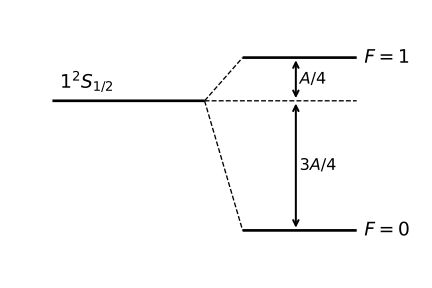
4. Example: Hydrogen ground state (\(1s_{1/2}\))
For the hydrogen atom in the ground state:
- Nuclear spin \(I=\tfrac{1}{2}\) (proton),
- Electronic total angular momentum \(J=\tfrac{1}{2}\) (from the \(1s_{1/2}\) electron).
Possible values of \(F\) are
\[ F = I+J = 1 \quad\text{and}\quad F = |I-J| = 0. \]
The hyperfine energies (relative to some reference) are
\[ \Delta E_{F} \;=\; \frac{A}{2}\big[ F(F+1) - I(I+1) - J(J+1)\big]. \]
Evaluating for \(F=1\) and \(F=0\) gives a doublet; the measured splitting (for hydrogen) corresponds to the well-known 21-cm line in astronomy.
5. Finite-nucleus and higher-order corrections
A few further points important for precision work:
- Finite nuclear size. The nucleus is not pointlike. For \(s\)-electrons the finite nuclear charge distribution modifies \(|\psi(0)|^2\) and therefore shifts \(A\). This is not a QED effect but is routinely included in precision hyperfine calculations.
- Electric quadrupole (\(k=2\)). If the nucleus has \(I\ge 1\), there is an additional quadrupole interaction, which splits \(F\) states further (tensor coupling).
- Higher-order QED corrections. Radiative corrections (self-energy, vacuum polarization, recoil, etc.) slightly modify \(A\) and the hyperfine energies; these are included when very high accuracy is required.
6. The Significance of Hyperfine Structure
The tiny energy shifts caused by the hyperfine interaction—the coupling between the electron’s total angular momentum and the nucleus’s spin—have profound and far-reaching consequences in modern physics and technology. While seemingly small, this interaction provides an exquisitely precise and stable quantum reference, which we can harness for a wide variety of applications.
Here are a few key examples:
Foundation of Atomic Clocks: Perhaps the most famous application is the atomic clock. The current definition of the SI second is based on the transition frequency between two hyperfine energy levels in a cesium-133 atom. This transition is so stable and precise that it allows for timekeeping with an accuracy of one second in millions of years. This incredible precision is essential for GPS, telecommunications, and a host of other technologies that rely on exact timing.
Quantum Computing and Qubits: The well-defined, stable energy levels of hyperfine states make them ideal candidates for building qubits, the fundamental units of quantum information. Systems like trapped ions and neutral atoms are used to encode quantum information in their hyperfine states, providing a robust platform for quantum computing and quantum simulation. Their long coherence times allow them to store information for an extended period, which is a crucial requirement for building a quantum computer.
Medical Imaging: Magnetic Resonance Imaging (MRI) relies on the principles of nuclear magnetic resonance (NMR), which is a form of hyperfine spectroscopy. In an MRI machine, a strong magnetic field is used to split the nuclear spin energy levels of hydrogen atoms in the body’s water molecules. By applying radiofrequency pulses, these nuclei can be excited and their subsequent relaxation provides detailed information about the tissues and organs, creating the high-resolution images used in medical diagnostics.
Chemical Analysis and NMR Spectroscopy: On a smaller scale, Nuclear Magnetic Resonance (NMR) spectroscopy is an indispensable tool in chemistry. It exploits the same principles as MRI to determine the structure of molecules. By analyzing the unique hyperfine splitting patterns of atomic nuclei, chemists can identify the types of atoms in a molecule and their spatial arrangement, providing a powerful method for structural elucidation.
Astrophysical Observations: Hyperfine transitions are also critical in astronomy. The famous 21-cm hydrogen line is a hyperfine transition in neutral atomic hydrogen. The radiation emitted or absorbed at this specific wavelength allows astronomers to map the distribution of vast clouds of interstellar hydrogen gas throughout our galaxy and beyond. This has provided invaluable insights into the structure and dynamics of the universe.
Fundamental Physics Research: The remarkable precision of hyperfine transitions makes them perfect for testing the fundamental laws of physics. By using atomic clocks, physicists can perform high-precision tests of General Relativity by measuring gravitational redshift. They are also used to search for new physics, such as a time variation of the fundamental constants of nature or violations of fundamental symmetries.
Metrology and Standards: Beyond the SI second, hyperfine transitions are used as highly stable frequency references for a variety of precision measurements. They form the basis of magnetometers and other sensitive measurement tools used in metrology and fundamental research.
4.1 Comments on the sign and ordering
The sign of \(A\) determines which \(F\) level lies higher. For hydrogen the \(F=1\) level lies above the \(F=0\) level (positive \(A\)), producing the emitted 21-cm photon for the \(F=1\to F=0\) transition in spontaneous emission.