Transition Processes and Einstein Coefficients
Atomic Transitions and Radiation: Overview and Plan
This chapter introduces the quantum-statistical description of how atoms interact with electromagnetic radiation. We focus on the fundamental processes of absorption, spontaneous emission, and stimulated emission, and show how these are quantified by the Einstein coefficients. Understanding these coefficients is crucial for linking microscopic atomic transitions to macroscopic radiation laws, such as Planck’s law, and for explaining phenomena like optical amplification and lasers.
The specific goals for this chapter are:
- Define the three fundamental atom–radiation processes — absorption, spontaneous emission, and stimulated emission — and identify the corresponding Einstein coefficients.
- Derive the relations between the Einstein coefficients by considering a two-level system in thermal equilibrium and applying the Boltzmann distribution.
- Connect microscopic transition rates to Planck’s law of black-body radiation, demonstrating the link between atomic physics and thermodynamics.
- Interpret the physical significance of the Einstein relations, including mode densities, the ratio of induced to spontaneous emission, population limits, and the basis for optical amplification.
- Appreciate the historical and conceptual insights of Einstein’s work, particularly the prediction of stimulated emission well before its experimental realization.
1. Historical Pretext
The question we address in this section is: How does the radiation field couple to the electronic degrees of freedom in atoms?
A key step toward a quantitative answer was taken by Albert Einstein in 1916 in his short but influential paper “Strahlungs-Emission und -Absorption nach der Quantentheorie”. This work appeared before the development of modern quantum mechanics (Schrödinger, Heisenberg) and at a time when the Bohr model of the atom was the dominant picture. Einstein’s analysis used only a few simple and physically motivated assumptions and produced striking results. The original paper is available online: Einstein (1916).
In his paper, Einstein argued that if one assumes atoms can absorb and emit radiation in ways consistent with the emerging ideas of quantum theory, then a system of atoms in thermal equilibrium will also be in equilibrium with blackbody radiation. From this condition, he was able to derive Planck’s radiation law in a remarkably simple and general fashion. The logic was that the quantum-theoretical distribution of atomic states should be consistent with energy exchange via emission and absorption of radiation alone.
Einstein’s treatment led to two historically important results:
An alternative derivation of Planck’s radiation law.
Planck’s original derivation (1900) relied on quantized energy exchange of oscillators. Einstein showed that Planck’s formula for blackbody radiation can also be obtained from the statistical balance between emission and absorption by atoms (or molecules) with discrete energy levels.A formulation anticipating Bohr’s second postulate and the probabilistic description of radiative transitions.
Bohr’s model already asserted that discrete transitions between stationary states occur with photon energy given by \[ h\nu = E_2 - E_1. \] Einstein went further by introducing coefficients that quantify transition probabilities: the coefficient \(A\) for spontaneous emission and the coefficients \(B\) for stimulated processes (absorption and stimulated emission). These Einstein coefficients provide a statistical (and dynamical) underpinning for the connection between discrete atomic energy levels and the properties of radiation in thermal equilibrium.
Einstein’s 1916 analysis thus provided a physically transparent bridge between Planck’s early quantum hypothesis and the later, more complete quantum theory of matter and radiation. In what follows we introduce the Einstein coefficients and derive their relation to the spectral energy density of radiation and to Planck’s law.
2. Definitions and System of Consideration
When an atom interacts with electromagnetic radiation, there are only three fundamental processes that can connect two energy levels, denoted here as a lower state \(|1\rangle\) and an upper state \(|2\rangle\):
- Spontaneous emission (the atom decays without external influence),
- Absorption (a photon is taken up and the atom is excited),
- Stimulated emission (the atom decays under the influence of the radiation field).
The probabilities of these processes are characterized by the Einstein coefficients. These coefficients describe how strongly the atom couples to radiation. The actual transition rates depend on both the atomic coefficients and on how much radiation is present at the relevant frequency.
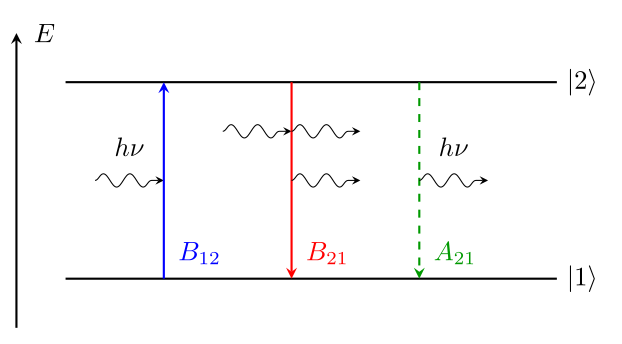
To make this precise, we first introduce the radiation field itself and then define the transition rates for each process.
Spectral energy density of the radiation field
The strength of the radiation field at frequency \(\nu\) is quantified by the spectral energy density:
\[ \mathcal{w}(\nu) = n(\nu)\, h\nu, \]
where
- \(n(\nu)\) is the number of photons per unit volume in the frequency interval \(\Delta\nu = 1~\text{s}^{-1}\),
- \(h\nu\) is the photon energy.
This quantity measures how much radiant energy per unit volume is available at frequency \(\nu\). In the following, \(\mathcal{w}(\nu)\) will appear as the factor describing the field strength in absorption and stimulated emission, while the Einstein coefficients specify the atomic response.
Transition probabilities
With this setup, we now define the transition probabilities for the three processes.
Spontaneous emission
Even in the absence of radiation, an excited atom in state \(|2\rangle\) will eventually decay to the lower state \(|1\rangle\), emitting a photon.
The probability per unit time for this is
\[ \frac{dP_{2 \to 1}^{\text{spont}}}{dt} = A_{21}, \]
where \(A_{21}\) is the Einstein coefficient for spontaneous emission.
- The emitted photons are distributed isotropically (in all directions).
- Their phases and directions are random, reflecting the quantum character of the process.
Absorption
If an atom is initially in the lower state \(|1\rangle\), it can absorb a photon of frequency \(\nu\) that matches the energy spacing between the levels:
\[ h\nu = E_2 - E_1. \]
The probability per unit time for this transition is
\[ \frac{dP_{1 \to 2}^{\text{abs}}}{dt} = B_{12}\, \mathcal{w}(\nu), \]
where \(B_{12}\) is the Einstein coefficient for absorption.
Thus the absorption rate is determined by the product of two factors:
- the atomic coupling strength (\(B_{12}\)),
- the available radiation energy at the right frequency (\(\mathcal{w}(\nu)\)).
Stimulated (induced) emission
Finally, if the atom is in the excited state \(|2\rangle\), the presence of radiation at the transition frequency can stimulate it to decay to the lower state \(|1\rangle\). In this process, a second photon is emitted that is identical to the stimulating one: same frequency, phase, and direction.
The probability per unit time is
\[ \frac{dP_{2 \to 1}^{\text{ind}}}{dt} = B_{21}\, \mathcal{w}(\nu), \]
with \(B_{21}\) the Einstein coefficient for stimulated emission.
This process provides the essential mechanism for optical amplification and is the foundation of the laser principle: light amplification by stimulated emission of radiation.
Summary
We have thus defined:
- \(A_{21}\) for spontaneous emission,
- \(B_{12}\) for absorption,
- \(B_{21}\) for stimulated emission.
Together with the spectral energy density \(\mathcal{w}(\nu)\), these coefficients provide a complete statistical description of matter–radiation interaction. In the next step, we will see how their balance in thermal equilibrium leads to Planck’s radiation law.
3. Transition Rates in Thermal Equilibrium
Let \(N_1\) and \(N_2\) denote the populations of the lower and upper states, respectively.
In the presence of radiation, absorption, stimulated emission, and spontaneous emission all contribute to population changes.
At steady state (detailed balance), the upward transition rate equals the total downward transition rate:
\[ B_{12}\,\mathcal{w}(\nu)\,N_1 = \big(B_{21}\,\mathcal{w}(\nu) + A_{21}\big)\,N_2. \tag{1}\]
Populations in thermal equilibrium
In thermal equilibrium at temperature \(T\), the ratio of level populations is given by the Boltzmann distribution:
\[ \frac{N_2}{N_1} = \frac{g_2}{g_1}\, e^{-h\nu/k_B T}, \tag{2}\]
where \(g_i = 2J_i+1\) denotes the degeneracy (statistical weight) of the level with total angular momentum \(J_i\).
Radiation field implied by equilibrium
Substituting Equation 2 into Equation 1 and solving for the spectral energy density \(\mathcal{w}(\nu)\) yields
\[ \mathcal{w}(\nu) = \frac{A_{21}/B_{21}}{\,(g_1/g_2)(B_{12}/B_{21})\, e^{h\nu/k_B T} - 1}. \tag{3}\]
For this to describe a physically consistent radiation field, \(\mathcal{w}(\nu)\) must reproduce the known equilibrium spectrum of blackbody radiation. In particular, as \(T \to \infty\), \(\mathcal{w}(\nu)\) should diverge. This requires the prefactor in the denominator to equal unity:
\[ \frac{g_1}{g_2}\,\frac{B_{12}}{B_{21}} = 1. \]
With this condition, the expression becomes structurally identical to Planck’s radiation law:
\[ \mathcal{w}(\nu) = \frac{8\pi h\nu^3}{c^3}\, \frac{1}{e^{h\nu/k_B T} - 1}. \tag{4}\]
Relations between Einstein coefficients
By comparing Equation 3 and Equation 4, one finds the fundamental relations:
Symmetry relation for absorption and stimulated emission \[ B_{21} = \frac{g_1}{g_2}\,B_{12}. \tag{5}\]
Link between spontaneous and stimulated emission \[ A_{21} = \frac{8\pi h\nu^3}{c^3}\,B_{21}. \tag{6}\]
These results show how the microscopic transition probabilities between discrete atomic states reproduce the macroscopic Planck distribution for black-body radiation.
Historical remark.
Einstein’s original derivation used Wien’s law as an input. By requiring that Equation 3 be a universal function of \(\nu\) and \(T\) (independent of the detailed structure of the atoms), he obtained the same relations between the coefficients. In this way, he built a bridge between atomic physics and thermodynamics, providing a conceptually new and independent route to Planck’s radiation law.
4. Physical Interpretation and Significance
The Einstein relations carry clear physical meaning and useful practical consequences.
Mode density and spontaneous emission
The factor \(\dfrac{8\pi\nu^2}{c^3}\) that appears in Equation 6 is the number of electromagnetic modes per unit volume in the frequency interval \(\Delta\nu = 1~\text{s}^{-1}\). Writing (6) as \[ A_{21} = \left(\frac{8\pi\nu^2}{c^3}\right)\, (h\nu)\, B_{21}, \] emphasizes that spontaneous emission can be viewed as emission into the vacuum modes of the field: the atomic coupling \(B_{21}\) multiplied by the zero-point occupancy (so to speak) of each mode and by the mode density yields the spontaneous rate.
Ratio of induced to spontaneous emission
Using \(\mathcal{w}(\nu)=n(\nu)\, h\nu\) and Equation 6, the ratio of induced (stimulated) to spontaneous emission into a single mode is \[ \frac{P_{2\to 1}^{\text{ind}}}{P_{2\to 1}^{\text{spont}}} = \frac{B_{21}\,\mathcal{w}(\nu)}{A_{21}} = \frac{B_{21}\,\rho(\nu)\,h\nu\,\bar n(\nu)}{\rho(\nu)\,h\nu\,B_{21}} = \bar n(\nu). \]
where
- \(\rho(\nu) = \tfrac{8\pi\nu^2}{c^3}\) is the density of electromagnetic modes, and
- \(\bar n(\nu) = n(\nu)/\rho(\nu)\) is the average photon number per mode at frequency \(\nu\).
- If \(\bar n(\nu)=0\) (no photons in the mode) emission still occurs via spontaneous emission — this is tied to vacuum fluctuations.
- If \(\bar n(\nu)\gg 1\) stimulated emission dominates and the emission rate grows linearly with the existing photon number — this is the basis for optical amplification and lasers.
It is important to distinguish between:
- \(n(\nu)\): the number of photons per unit volume per unit frequency,
- \(\rho(\nu)\): the density of electromagnetic modes per unit volume per unit frequency, and
- \(\bar n(\nu) = n(\nu)/\rho(\nu)\): the average photon number per mode.
The ratio of induced to spontaneous emission rates equals \(\bar n(\nu)\), not \(n_V(\nu)\).
This explains why spontaneous emission can be interpreted as emission into the vacuum field (\(\bar n=0\)), while stimulated emission requires already occupied modes (\(\bar n>0\)).
Consequences of the \(B\)-coefficient symmetry
The symmetry \[ B_{12} = \frac{g_2}{g_1}\, B_{21} \] ensures detailed balance between absorption and stimulated emission in thermal equilibrium. A few important consequences:
Steady-state excitation under intense illumination.
If the radiation is so strong that stimulated processes dominate (\(\mathcal{w}(\nu)\) large enough that \(B\mathcal{w}\gg A\)), the steady-state condition Equation 1 reduces approximately to \[ B_{12}\,\mathcal{w}\,N_1 \approx B_{21}\,\mathcal{w}\,N_2 \quad\Rightarrow\quad \frac{N_2}{N_1} \approx \frac{B_{12}}{B_{21}} = \frac{g_2}{g_1}. \] Thus, for equal degeneracies (\(g_1=g_2\)) the maximum steady-state excitation under very strong resonant illumination is \(N_2/N_1 \approx 1\), i.e. at most 50% of the atoms are in the excited state. This shows why a two-level system cannot sustain a population inversion by simple resonant pumping — some form of shelving or multi-level pumping is required to achieve inversion needed for lasing.Role of degeneracy.
If \(g_2>g_1\), then under strong illumination the upper level population can exceed 50% (since \(N_2/N_1 \approx g_2/g_1\)). This is one route (though rarely sufficient alone) toward favorable conditions for inversion.
The symmetry relation \[ g_1 B_{12} = g_2 B_{21} \] is essential for thermodynamic consistency.
Why: In thermal equilibrium at temperature \(T\), the populations of two atomic levels must follow the Boltzmann distribution \[ \frac{N_2}{N_1} = \frac{g_2}{g_1} e^{-h\nu/k_B T}. \] If the \(B\) coefficients were not related by the symmetry, the rate equations would predict a different population ratio than Boltzmann’s law.
Consequence: This mismatch would allow a cycle in which atoms and the radiation field exchange energy in a way that systematically decreases the total entropy of the system. In other words, one could construct a hypothetical “perpetual motion machine of the second kind,” violating the Second Law of Thermodynamics.
Takeaway: The Einstein \(B\)-coefficient symmetry ensures that detailed balance is satisfied, the radiation field and atomic populations are mutually consistent, and the Second Law is preserved.
Conceptual summary
- Spontaneous emission connects atoms to the vacuum mode structure of the electromagnetic field.
- Stimulated emission couples atoms to real photons and can amplify light when many photons are present.
- The Einstein relations ensure that atomic transition probabilities and the mode structure of the radiation field combine to give the universal Planck spectrum at thermal equilibrium.
- Practically, the \(B\)-coefficient symmetry explains why simple two-level pumping cannot produce sustained inversion and motivates multi-level schemes used in real lasers.