Up to this point, we have mainly discussed the static structure of atoms — their energy levels, term symbols, and how these arise from electron–electron and spin–orbit interactions. However, the dynamics of how atoms respond to external perturbations is just as fundamental:
How do atoms become excited or ionized?
What are the probabilities and timescales of such processes?
How do atomic configurations rearrange once an electron is promoted or removed?
Atoms can be excited or ionized through two main mechanisms:
Absorption of photons (radiative excitation or photoionization)
Collisions with electrons, ions, or neutral particles (impact excitation or collisional ionization)
Understanding these processes is a central theme in atomic, molecular, and optical (AMO) physics. They play a key role in a wide range of applications — from astrophysical plasma diagnostics, laser spectroscopy, and radiation damage in biological systems, to quantum information processing and precision metrology.
In this chapter, we will not attempt to cover the full complexity of atomic excitation and scattering. Instead, we will focus on a few simple but representative scenarios that illustrate the underlying physics and connect to real-world experiments.
1. Single-Electron Excitation
In many atoms, low-lying excited configurations can be described as single-electron excitations: one electron is promoted to a higher orbital while the rest of the atom remains in its ground-state configuration. This picture relies on the independent-electron approximation, where each electron moves in an effective potential generated by the nucleus and the average field of the other electrons.
Note:
The term “singly excited configuration” typically refers to states where exactly one electron occupies a higher orbital than in the ground state. In contrast, excited terms within the same configuration (arising from different couplings of \(L\) and \(S\)) are not considered “singly excited configurations,” even though their energies differ.
However, because the electrons interact via the Coulomb force, changing the state of one electron modifies the entire potential, so the single-electron model is only an approximation.
1.1 Example: Beryllium
Beryllium provides a simple example. Its ground-state configuration is:
\[
1s^2 2s^2 \quad ({}^1S_0)
\]
The lowest singly excited configurations involve promoting one of the \(2s\) electrons to a \(2p\) or higher orbital:
Configuration
Term Symbol
Excitation Energy (eV)
Comment
\(1s^2 2s^2\)
\({}^1S_0\)
0.00
Ground state
\(1s^2 2s 2p\)
\({}^1P_1\)
5.28
Dipole-allowed excited state
\(1s^2 2p^2\)
\({}^1D_2\)
6.70
Doubly excited
Continuum
—
9.32
Ionization threshold
1.2 Typical Lifetimes of Excited States
The lifetime of an excited state is inversely proportional to its radiative decay rate\(A_{21}\):
which means that higher transition frequencies \(\omega\) and stronger dipole matrix elements lead to faster decays.
Atom / Transition
Lifetime (\(\tau\))
Energy (\(\hbar\omega\))
H (\(2^2P_{3/2} \to 1^2S_{1/2}\))
1.5 ns
10.2 eV
He (\(2^1P_1 \to 1^1S_0\))
0.5 ns
21.2 eV
Na (\(3^2P_{1/2} \to 3^2S_{1/2}\))
16 ns
2.1 eV
In atomic units, the binding energy of a Rydberg state scales approximately as \(E_n \propto 1/n^2\), so the energy spacing between adjacent levels decreases rapidly with increasing \(n\). This implies that radiative transitions between nearby Rydberg levels involve smaller photon energies and generally weaker dipole coupling. A detailed analysis—taking into account both the scaling of dipole matrix elements and the density of accessible final states—shows that the corresponding lifetimes increase roughly as \(n^3\). This often-cited scaling, however, is not obvious from simple arguments and depends on assumptions about which decay channels dominate and how many are available.
Importantly, this \(n^3\) scaling applies primarily to transitions between neighboring states of similar orbital angular momentum \(\ell\). Low-\(\ell\) Rydberg states (such as \(s\) or \(p\) states) can also decay directly to the ground state via high-frequency dipole transitions with large \(\omega\), which shortens their lifetimes dramatically. In contrast, high-\(\ell\) states—which have poor radial overlap with the ground state and are often dipole-forbidden for large \(\Delta \ell\)—are metastable, exhibiting lifetimes that can reach microseconds to milliseconds, even in light atoms.
Thus, the long lifetimes of Rydberg states arise not simply from the \(1/n^2\) energy scaling, but from a combination of small level spacings and restricted dipole coupling due to angular momentum and selection-rule effects.
1.3 Metastable States
Some excited states have very long lifetimes because the lowest-order (electric-dipole) transitions to lower levels are forbidden by the selection rules. As a result, decay must proceed via higher-order processes (magnetic dipole, electric quadrupole, or even two-photon transitions), or via weak mixing with allowed states — all of which lead to much smaller transition rates and therefore long lifetimes.
Atom / State
Lifetime (\(\tau\))
Decay Type
H (\(2^2S_{1/2}\))
8 s
Two-photon decay
He (\(2^1S_0\))
19.6 ms
Two-photon decay
He (\(2^3S_1\))
7870 s
Magnetic dipole (M1)
Such metastable levels play a crucial role in many areas of atomic physics. Because their radiative decay is strongly suppressed, they can store population for long times — a prerequisite for population inversion and thus for lasing. In some special cases, such as metastable helium, these long-lived states can also serve as effectively stable starting points for laser cooling and precision spectroscopy, since they can be selectively excited and manipulated without rapid decay.
2. Doubly Excited States
An atom is said to be doubly excited when two of its electrons are promoted from their ground-state configuration. Such configurations reveal strong electron–electron correlations, since both excited electrons interact not only with the ionic core but also strongly with each other. They represent an important step beyond the independent-electron model introduced for singly excited states.
2.1 Example: Doubly Excited States in Beryllium
We have already encountered beryllium (Be) in the previous section, where single-electron excitations could be described fairly well within the independent-electron approximation. However, this picture begins to fail when two electrons are excited simultaneously. In that case, the interaction between the two excited electrons becomes crucial, and their motion can no longer be treated independently — leading to strongly correlated, doubly excited states.
Ground-State Configuration
The ground state of beryllium is:
\[
1s^2 2s^2 \; ({}^1S_0)
\]
Here both \(1s\) and \(2s\) subshells are completely filled, resulting in a closed-shell singlet (\(S=0\), \(L=0\)).
Doubly Excited Configurations
If we excite both 2s electrons, several configurations become possible, such as:
\[
1s^2 2p^2
\]
These states have two electrons in the \(2p\) subshell and therefore allow multiple possible term symbols depending on how the angular momenta couple:
Each term represents a different total spin \(S\) and orbital angular momentum \(L\) combination that can arise from coupling two \(p\) electrons. For example:
- The \({}^1D_2\) and \({}^1S_0\) are singlet states (\(S=0\)),
- while the \({}^3P_J\) terms (\(S=1\)) form a triplet.
Because all these states share the same electronic configuration, their energy differences arise solely from electron–electron interactions (Coulomb and exchange effects), with smaller contributions from spin–orbit coupling. Hence, they serve as an excellent example to illustrate correlation effects in multi-electron atoms.
Energetics
Approximate energy ordering (in eV, relative to the ground state):
Configuration
Term
Energy (eV)
Comment
\(1s^2 2p^2\)
\({}^1S_0\)
9.45
Doubly excited
\(1s^2 2p^2\)
\({}^3P_{0,1,2}\)
7.40
Doubly excited
\(1s^2 2p^2\)
\({}^1D_2\)
7.05
Doubly excited
\(1s^2 2s2p\)
\({}^1P_1\)
5.28
Singly excited
\(1s^2 2s2p\)
\({}^3P_{0,1,2}\)
2.73
Singly excited
\(1s^2 2s^2\)
\({}^1S_0\)
0.00
Ground state
—
—
9.32
Ionization threshold
*Note: Despite Hund’s rule predicting the triplet state (\({}^{3}P\)) to be lower in energy, the observed \(1s^{2}2p^{2}\) excited state of beryllium shows a reversed ordering where the singlet state (\({}^{1}D\)) is lower. This can occasionally happen for excited states in light atoms, where strong quantum mechanical mixing between electron configurations, known as configuration interaction, can significantly alter the expected energy levels.
2.2 Radiative Decay Channels
Doubly excited states lying below the first ionization threshold decay radiatively back to the ground state.
For the \(1s^2 2p^2\) configuration in beryllium, a direct one-photon decay from \({}^1D_2 \rightarrow {}^1S_0\) is electric-dipole forbidden because it violates the dipole selection rule \(\Delta L = \pm 1\). However, these doubly excited states can decay efficiently via a two-step cascade through singly excited intermediate states, such as:
Both transitions in this cascade are electric-dipole allowed, making the overall decay rate relatively fast (lifetimes typically on the order of nanoseconds). While direct two-photon emission—where the atom simultaneously emits two photons whose combined energy matches the energy difference between initial and final states—remains possible in principle, the cascade pathway dominates due to its much higher transition rate.
In contrast, the triplet states such as \(1s^2 2p^2 \; ({}^3P_{0,1,2})\) cannot easily decay to the singlet ground state \(1s^2 2s^2 \; ({}^1S_0)\) because electric-dipole transitions require \(\Delta S = 0\). Their decay therefore proceeds only via spin-forbidden intercombination transitions or weak magnetic-dipole (M1) or electric-quadrupole (E2) processes, resulting in much longer lifetimes than for the corresponding singlet states.
2.3 Autoionization
When a doubly excited state lies above the first ionization threshold, it becomes energetically unstable with respect to electron emission. In such cases, the atom can decay by transferring energy from one excited electron to the other—causing one electron to relax while the other escapes to the continuum. This radiationless decay process is known as autoionization.
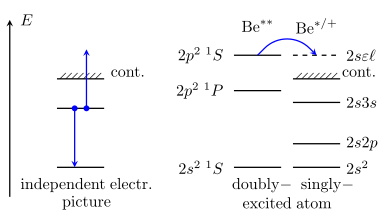
The figure below schematically illustrates this mechanism. Initially, both electrons occupy excited orbitals; as one electron decays to a lower level, its released energy is transferred through electron–electron interaction to the second electron, which escapes from the atom. In this sense, the doubly excited state couples to the continuum of singly ionized states. The interaction between this discrete state and the continuum leads to a finite lifetime—typically a few femtoseconds—corresponding to a natural linewidth of several tens of meV.
In the independent electron picture (left), each electron occupies an orbital with a specific energy. A doubly excited state such as \(2s^22p^2\,{}^1S\) has both electrons in excited orbitals. The total electronic energy of the atom is shown in the two diagrams on the right. Doubly excited states lying above the first ionization threshold (hatched continuum region) can autoionize by ejecting one electron, transitioning from Be\(^{**}\) to Be\(^+\).
Example: Autoionization of the \({}^1S_0\) Doubly Excited State in Be
In beryllium, the \({}^1S_0\) state of the \(1s^2 2p^2\) configuration lies around 9.45 eV, slightly above the ionization threshold at 9.32 eV. Because it lies above this limit, the state is embedded in the continuum of singly ionized configurations such as \(1s^2 2s \, \varepsilon p\).
The dominant decay channel is therefore autoionization:
Here the double asterisk (Be\(^{**}\)) denotes a doubly excited neutral atom, while Be\(^+\) represents the singly ionized ion. During the decay, one \(2p\) electron relaxes into the \(2s\) orbital, and the excess energy is transferred to the second electron, which escapes with a kinetic energy equal to the difference between the doubly excited energy and the ionization threshold.
Although a radiative decay to a bound state (for instance, via two-photon emission) is in principle possible, it is typically several orders of magnitude slower and thus negligible compared to the dominant autoionization channel.
Selection Rules and Open Autoionization Channels
The autoionization process is mediated entirely by electron–electron interaction, rather than by coupling to the radiation field. Consequently, its selection rules differ from those of electric-dipole transitions:
Total parity is conserved.
Total angular momentum (\(J\)) is conserved, but the continuum electron can carry any orbital angular momentum \(\ell\) needed to satisfy this condition.
Because the continuum wavefunction provides a wide range of possible \(\ell\) values, there are always open autoionization channels available—provided the energy is sufficient. This is in contrast to radiative decay, which is restricted by strict dipole rules (\(\Delta L = \pm 1\), \(\Delta S = 0\)) and therefore often forbidden for doubly excited configurations such as \({}^1S_0 \rightarrow {}^1S_0\).
Fano Resonances
Experimentally, autoionizing states appear as asymmetric line shapes in photoabsorption spectra—known as Fano resonances. These arise from quantum interference between two competing excitation pathways:
where \(\epsilon = (E - E_r)/(\Gamma/2)\), \(E_r\) is the resonance energy, \(\Gamma\) is the full width at half maximum (FWHM) related to the autoionization lifetime by \(\Gamma = \hbar/\tau\), and \(q\) is the Fano asymmetry parameter describing the interference strength.
A typical resonance profile for Be’s \({}^1S_0\) doubly excited state (assuming a Fano paramter of \(q=-2\)) is shown below.
Code
import numpy as npimport matplotlib.pyplot as pltplt.rcParams['text.usetex'] =Trueplt.rcParams['font.family'] ='serif'plt.rcParams['font.size'] =12# Physical parameters for BerylliumE_ionization =9.32# eV - ionization thresholdE_resonance =9.45# eV - doubly excited 2p^2 stateGamma =0.01# eV - autoionization width (~10 meV, typical value)# Energy range around the resonanceE = np.linspace(E_ionization+0.05, 9.65, 1000)# Reduced energy variableepsilon = (E - E_resonance) / (Gamma /2)# Function to calculate Fano profiledef fano_profile(epsilon, q):return (q + epsilon)**2/ (1+ epsilon**2)# Create figure with multiple q valuesfig, ax = plt.subplots(figsize=(7.5, 4))# Different asymmetry parameters to demonstrate the effectq =-2.0#[-13.38, 1.0, 3.0, -2.0]sigma = fano_profile(epsilon, q)ax.plot(E, sigma, 'b-', linewidth=2, label=f'q = {q}')ax.axvline(E_ionization, color='red', linestyle='--', linewidth=1.5, label='Ionization threshold')ax.axvline(E_resonance, color='green', linestyle='--', linewidth=1.5, label='Resonance energy')ax.set_xlabel('Photon Energy (eV)', fontsize=12)ax.set_ylabel('Cross Section (arb. units)', fontsize=12)ax.grid(True, alpha=0.3)ax.legend(fontsize=9)ax.set_ylim([0, max(sigma) *1.1])plt.tight_layout()plt.show()
2.4 Core Holes and Auger Decay
While autoionization involves energy transfer between two excited electrons, a closely related process occurs after inner-shell ionization or core excitation. When an inner-shell electron (for instance, from the \(1s\) orbital) is removed or excited, a core hole is created. The atom is then in a highly unstable state with excess internal energy, and it can relax through two competing pathways:
Radiative decay (fluorescence):
A higher-lying electron fills the core hole, and the excess energy is emitted as a photon (often an X-ray).
Auger decay:
Instead of emitting a photon, the released energy is transferred to another electron, which is then ejected from the atom with a characteristic kinetic energy. This process can be represented schematically as:
\[
A^{**} \;\longrightarrow\; A^{+} + e^-
\]
where \(A^{**}\) denotes the atom with a core hole, and the emitted Auger electron carries away the energy difference between the initial and final electronic configurations.
Competition Between Fluorescence and Auger Decay
The relative probability of these two decay channels is described by the fluorescence yield—the fraction of core-hole decays that produce a photon rather than an Auger electron. This yield depends strongly on the atomic number \(Z\):
For light elements (\(Z \lesssim 30\)), Auger decay dominates, since electron–electron interactions are strong compared to radiative coupling.
For heavy elements, radiative rates increase rapidly (approximately \(\propto Z^4\)), and fluorescence becomes dominant.
Typical trends:
Atomic number range
Dominant process
Approximate fluorescence yield
\(Z < 30\)
Auger decay
≈ 10%
\(Z \sim 30\)–50
Comparable
10–50%
\(Z > 50\)
Fluorescence
>80%
In summary, Auger decay is a non-radiative relaxation mechanism driven entirely by electron–electron interaction, closely analogous to autoionization, but initiated by the creation of a core hole rather than a doubly excited state. It plays a central role in surface analysis (Auger electron spectroscopy), radiation damage, and inner-shell dynamics in atoms and molecules.