Spectroscopy and Spectral Line Widths

Author

Daniel Fischer

Spectroscopy and Spectral Line Widths: Overview and Plan

This section introduces the origins of spectral line widths in atomic spectroscopy and how different physical effects shape the observed profiles. We begin with the natural linewidth that arises from the finite lifetime of excited states, then examine the role of coherence and subtle departures from the simple exponential decay model. Finally, we explore Doppler broadening in gases and compare its magnitude to intrinsic atomic energy scales.

Specific goals:

  1. Derive the natural linewidth from the finite excited-state lifetime and connect it to the uncertainty principle.
  2. Discuss subtleties of coherence and the approximations behind the exponential decay law.
  3. Introduce Doppler broadening as the dominant broadening mechanism in gases at room temperature and compare it to natural and fine-structure scales.

By the end of this section students should understand the physical origin of line broadening, be able to distinguish between natural and Doppler contributions, and appreciate how these effects determine the resolution of spectroscopic measurements.


1. Spectroscopy and Spectral Lines

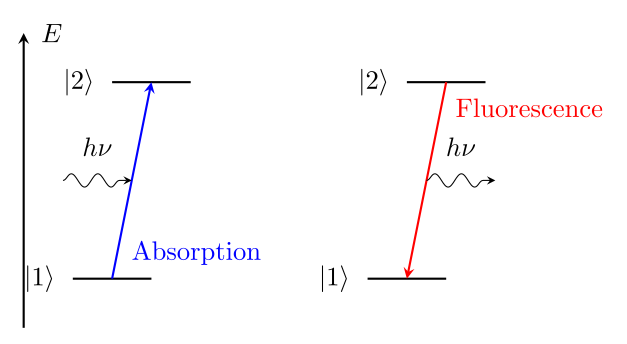
In spectroscopy we measure the energy difference between two atomic states by detecting how atoms interact with light of frequency \(\nu\). The resonance condition is \[ h\nu = E_2 - E_1, \] so by scanning \(\nu\) and monitoring absorption or emission we can determine level spacings with high precision.

Two common methods are:

  • Absorption spectroscopy: a laser beam is passed through an ensemble of atoms. At resonance, photons are absorbed and the transmitted intensity drops.
  • Fluorescence spectroscopy: atoms are excited with resonant light, and the re-emitted photons (fluorescence) are detected.

Both methods reveal the same resonance condition but may differ in sensitivity or background noise.

Principle of absorption and fluorescence spectroscopy

Principle of absorption and fluorescence spectroscopy

1.1 Line Properties

A spectral line is not infinitely sharp. Instead, it has a finite profile centered around the resonance frequency \(\nu_0\) with a maximum intensity \(P_0\). The width of this profile contains important physical information.

The figure below shows a typical line profile (here drawn as a Gaussian). The full width at half maximum (FWHM), denoted \(\delta\nu = \nu_2 - \nu_1\), is the standard measure of line width. The central region is the line core, while the tails are called the line wings.

Code
import numpy as np
import matplotlib.pyplot as plt
from scipy.stats import norm

# Enable LaTeX rendering
plt.rcParams['text.usetex'] = True
plt.rcParams['font.family'] = 'serif'
plt.rcParams['font.size'] = 15

# Create figure and axis
fig, ax = plt.subplots(figsize=(10, 6))

# Define the line profile parameters
v0 = 0  # Center frequency
sigma = 1  # Standard deviation for Gaussian profile
v = np.linspace(-4, 4, 1000)

# Create Gaussian profile for the spectral line
P = norm.pdf(v, v0, sigma)
P = P / P.max()  # Normalize to peak at 1

# Define key positions
P0 = 1.0  # Peak intensity
P_half = 0.5  # Half maximum

# Find FWHM positions (Full Width at Half Maximum)
idx_half_left = np.argmin(np.abs(P[:500] - P_half))
idx_half_right = np.argmin(np.abs(P[500:] - P_half)) + 500
v1 = v[idx_half_left]
v2 = v[idx_half_right]

# Plot the main curve
ax.plot(v, P, 'r-', linewidth=2)

# Fill areas
# Line core (Linienkern)
core_mask = (v >= v1) & (v <= v2)
ax.fill_between(v[core_mask], 0, P[core_mask], alpha=0.5, color='salmon', label='Line core')

# Line wings (Linienflügel)
left_wing_mask = v < v1
right_wing_mask = v > v2
ax.fill_between(v[left_wing_mask], 0, P[left_wing_mask], alpha=0.3, color='lightcoral')
ax.fill_between(v[right_wing_mask], 0, P[right_wing_mask], alpha=0.3, color='lightcoral')

# Add horizontal dashed lines
ax.plot([-4,0], [P0,P0] , 'k--', linewidth=1)
ax.plot([-4,0], [P_half,P_half] , 'k--', linewidth=1)

# Add vertical lines
ax.plot([v0, v0], [0, P0], 'k-', linewidth=1.5)
ax.plot([v1, v1], [0, P_half], 'k--', linewidth=1)
ax.plot([v2, v2], [0, P_half], 'k--', linewidth=1)

# Add annotations for δν (line width)
ax.annotate('', xy=(v2, P_half), xytext=(v1, P_half),
            arrowprops=dict(arrowstyle='<->', color='black', lw=1.5))
ax.text(v0 + 0.2, P_half + 0.01, r'$\delta\nu$', ha='center', fontsize=18)

# Add labels
ax.text(1.12, 0.74, r'Line core', fontsize=18, transform=ax.transData)
ax.plot([1.1, 0.5], [0.73, 0.65], 'k-', linewidth=0.5)

ax.text(2.5, 0.25, r'Line wing', fontsize=18)
ax.plot([2.45, 1.7], [0.24, 0.1], 'k-', linewidth=0.5)


# Y-axis labels
ax.text(-4.3, P0, r'$P_0$', ha='left', va='center', fontsize=15)
ax.text(-4.5, P_half, r'$P_0/2$', ha='left', va='center', fontsize=15)

# X-axis labels
ax.text(v1, -0.021, r'$\nu_1$', ha='center', va='top', fontsize=18)
ax.text(v0, -0.021, r'$\nu_0$', ha='center', va='top', fontsize=18)
ax.text(v2, -0.021, r'$\nu_2$', ha='center', va='top', fontsize=18)

# Set labels and title
ax.set_xlabel(r'$\nu$', loc='right', fontsize=16)
ax.set_ylabel(r'$P(\nu)$', loc='top', fontsize=16)
#ax.set_title(r'Line Profile of a Spectral Line', fontsize=1, pad=15)

# Set axis limits
ax.set_xlim(-4, 4)
ax.set_ylim(0, 1.15)

# Remove tick marks and labels
ax.set_xticks([])
ax.set_yticks([])

# Remove top and right spines
ax.spines['top'].set_visible(False)
ax.spines['right'].set_visible(False)

# Set grid
ax.grid(alpha=0.3, linestyle=':', linewidth=0.5)

plt.tight_layout()
plt.show()
Profile of a spectral line.

Profile of a spectral line.

1.2 Observed Line Widths and Broadening

In practice, several physical and technical mechanisms contribute to the observed line width:

  • Natural line width
    Even in isolation, an excited state has a finite lifetime \(\tau\). The time–energy uncertainty relation implies a frequency width
    \[ \delta\nu_\text{nat} \sim \frac{1}{2\pi \tau}. \] This is an intrinsic property of the transition.

  • Doppler broadening
    In a gas, atoms move with thermal velocities. Due to the Doppler effect, each atom perceives the light frequency shifted by \(\pm v/c\). The result is a Gaussian broadening of the line profile, which typically dominates at room temperature.

  • Collisional (pressure) broadening
    Collisions between atoms perturb the energy levels and interrupt the coherent phase of emission. This shortens the effective lifetime and leads to Lorentzian broadening that grows with gas density or pressure.

  • Power (intensity) broadening
    At high laser intensities, the optical transition saturates. Rapid Rabi cycling between ground and excited states effectively shortens the coherence time, broadening the line.

  • Instrumental resolution
    The spectrometer itself has finite frequency resolution (set by grating, interferometer, or laser linewidth). This must be folded into the observed profile.

In the following sections we will examine the natural linewidth and Doppler broadening in detail, as these are the most fundamental and unavoidable mechanisms.

2. Natural Line Width

The natural line width is an intrinsic property of any atomic transition. It originates from the fact that an excited state has only a finite lifetime. As a result, the emitted radiation cannot be perfectly monochromatic but acquires a characteristic spectral width.

In the discussion of time-dependent superpositions, we saw that during a transition the atomic state is not purely ground or excited, but can be written as a coherent superposition of stationary eigenstates, \[ |\psi(t)\rangle = c_1(t)\,|1\rangle\,e^{-i\omega_1 t} + c_2(t)\,|2\rangle\,e^{-i\omega_2 t}, \] with \(|c_1(t)|^2 + |c_2(t)|^2 = 1\).

For spontaneous emission the excited-state population decays exponentially, \[ P_2(t) = |c_2(t)|^2 = e^{-\Gamma t}, \] where \(\Gamma\) is the decay rate. This is the same decay law that appears in the Einstein rate equations (see Transition Processes and Einstein Coefficients).


2.1 The oscillating dipole

The radiated field is driven by the atomic dipole expectation value \[ \vec{D}(t) = -e \,\langle \psi(t)| \vec{r} | \psi(t)\rangle . \] Keeping only the rapidly oscillating coherence term, one finds \[ \vec{D}(t) \;\propto\; c_1^*(t)c_2(t)\, e^{-i(\omega_2 - \omega_1)t} + \text{c.c.}, \] so that the dipole oscillates at the transition frequency \[ \omega_{21} = \omega_2 - \omega_1, \] with an envelope determined by the product \(c_1^*(t)c_2(t)\).

To a good approximation this envelope decays exponentially,
\[ c_1^*(t)c_2(t) \sim e^{-\Gamma t/2}, \] so that \(\vec{D}(t)\) resembles a damped harmonic oscillator: a sinusoidal oscillation under an exponentially decaying envelope.

Code
import numpy as np
import matplotlib.pyplot as plt
from scipy.integrate import tplquad


# Enable LaTeX rendering
plt.rcParams['text.usetex'] = True
plt.rcParams['font.family'] = 'serif'
plt.rcParams['font.size'] = 15


def time_dependent_amplitudes(t, tau):
    """
    Time-dependent amplitudes with exponential decay
    c2(t) = exp(-t/tau), c1(t) = sqrt(1 - c2(t)²)
    
    Parameters:
    t: time
    tau: decay time constant
    """
    c2_t = np.exp(-t / tau)
    c1_t = np.sqrt(1 - c2_t**2)
    
    return c1_t, c2_t

def expectation_z_with_decay(t, tau):
    """
    Expectation value of z with time-dependent decay
    """
    # Get time-dependent amplitudes
    c1_t, c2_t = time_dependent_amplitudes(t, tau)
    
    # Energy levels (atomic units)
    E1 = -1/2  # 1s energy
    E2 = -1/8  # 2p energy
    
    # Transition frequency
    omega_21 = (E2 - E1)  # = 3/8
    
    # Matrix element
    matrix_element_1s_2p = -128 * np.sqrt(2) / (3**5)
    
    # Expectation value with time-dependent amplitudes
    expectation_z = 2 * c1_t * c2_t * matrix_element_1s_2p * np.cos(omega_21 * t)
    
    return expectation_z


def plot_decaying_oscillation():
    """
    Plot ⟨z⟩ with exponential decay of c2
    """
    # Calculate decay time constant (10 times oscillation period)
    omega_21 = 3/8
    period = 2*np.pi / omega_21
    tau = 10 * period  # Decay time constant
    
    # Time array
    t_max = 10 * tau  # Show 5 decay constants
    t = np.linspace(0, t_max, 2000)
    
    # Calculate expectation values
    z_exp_decay = expectation_z_with_decay(t, tau)
    
    # Get time-dependent amplitudes for plotting
    c1_t, c2_t = time_dependent_amplitudes(t, tau)
    
    # Create comprehensive plot
    #fig, axes = plt.subplots(3, 1, figsize=(14, 12))
    plt.figure(figsize=(10, 8))
    
    # Plot 1: Expectation value with decay
    plt.plot(t, z_exp_decay, 'b-', linewidth=2, label='⟨z⟩(t)')
    
    # Add envelope (decay of amplitude)
    matrix_element = -128 * np.sqrt(2) / (3**5)
    envelope_upper = 2 * c1_t * c2_t * abs(matrix_element)
    envelope_lower = -envelope_upper

    
    plt.plot(t, envelope_upper, 'r--', alpha=0.7, linewidth=1.5, label='Envelope')
    plt.plot(t, envelope_lower, 'r--', alpha=0.7, linewidth=1.5)
    plt.fill_between(t, envelope_lower, envelope_upper, alpha=0.1, color='red')


    plt.xlabel('Time (atomic units)')
    plt.ylabel('⟨z⟩ (Bohr radii)')
    plt.grid(True, alpha=0.3)
    plt.xlim(100, 800)
    plt.ylim(-1, 1)
    plt.legend()
    
    plt.tight_layout()
    
    return fig

    
plot_decaying_oscillation()
plt.show()

Time evolution of the expectation value of the dipole operator $\langle z(t)\rangle$ for a two-level atom undergoing spontaneous decay. The oscillation at the transition frequency is modulated by an exponentially decaying envelope, analogous to a damped harmonic oscillator. The red dashed lines indicate the decay envelope.

Time evolution of the expectation value of the dipole operator \(\langle z(t)\rangle\) for a two-level atom undergoing spontaneous decay (qualitatively). The oscillation at the transition frequency is modulated by an exponentially decaying envelope, analogous to a damped harmonic oscillator. The red dashed lines indicate the decay envelope.

2.2 From time to frequency

The spectral profile of the emitted radiation is obtained by Fourier transforming this time-domain signal. The Fourier transform of an exponential decay yields a Lorentzian function, \[ I(\omega) \;\propto\; \frac{\tfrac{\Gamma}{2}}{(\omega - \omega_{21})^2 + (\tfrac{\Gamma}{2})^2}. \]

This is the natural line shape. The full width at half maximum (FWHM) of the Lorentzian is \[ \delta\omega = \Gamma, \] or equivalently in frequency units \(\delta\nu = \Gamma/(2\pi)\).

The radiated field is proportional to the time-dependent dipole moment, which has the form of a damped harmonic oscillator. We can represent this signal with a complex exponential: \[ \vec{D}(t) \;\propto\; \theta(t) e^{-\Gamma t/2} e^{-i\omega_{21}t} \] where \(\theta(t)\) is the Heaviside step function, which accounts for the fact that the emission starts at \(t=0\).

The Fourier transform, \(I(\omega)\), of a time-domain signal \(f(t)\) is defined as: \[ F(\omega) = \int_{-\infty}^{\infty} f(t) e^{i\omega t} dt \] Substituting our signal \(\vec{D}(t)\) (and ignoring constant prefactors for simplicity) and applying the Heaviside function limit of integration, we get: \[ F(\omega) \;\propto\; \int_0^{\infty} e^{-\Gamma t/2} e^{-i\omega_{21}t} e^{i\omega t} dt \] Combining the exponential terms: \[ F(\omega) \;\propto\; \int_0^{\infty} e^{-(\Gamma/2 + i(\omega_{21}-\omega))t} dt \] This is a standard integral of the form \(\int e^{-at}dt\), which evaluates to \(-\frac{1}{a}e^{-at}\): \[ F(\omega) \;\propto\; \left[ -\frac{e^{-(\Gamma/2 + i(\omega_{21}-\omega))t}}{\Gamma/2 + i(\omega_{21}-\omega)} \right]_0^{\infty} \] Evaluating the limits: \[ F(\omega) \;\propto\; 0 - \left( -\frac{e^0}{\Gamma/2 + i(\omega_{21}-\omega)} \right) = \frac{1}{\Gamma/2 + i(\omega_{21}-\omega)} \] The spectral intensity \(I(\omega)\) is proportional to the absolute square of the Fourier transform: \[ I(\omega) \;\propto\; |F(\omega)|^2 = \left| \frac{1}{\Gamma/2 + i(\omega_{21}-\omega)} \right|^2 \] \[ I(\omega) = \frac{\tfrac{\Gamma}{2}}{(\omega - \omega_{21})^2 + (\tfrac{\Gamma}{2})^2} \] The last step introduces the factor of \(\Gamma/2\) to normalize the peak intensity, but the dependence on frequency is the key result. This is exactly the Lorentzian line shape.

Code
import numpy as np
import matplotlib.pyplot as plt
from scipy.stats import norm, cauchy

# Enable LaTeX rendering
plt.rcParams['text.usetex'] = True
plt.rcParams['font.family'] = 'serif'
plt.rcParams['font.size'] = 15

# Create figure and axis
fig, ax = plt.subplots(figsize=(10, 6))

# Define the line profile parameters
v0 = 0  # Center frequency
sigma = 1  # Standard deviation for Gaussian profile
v = np.linspace(-4, 4, 1000)

# Create Gaussian and Lorentzian profile for the spectral line
P = norm.pdf(v, v0, sigma/2.35)
P = P / P.max()  # Normalize to peak at 1
L = cauchy.pdf(2*(v-v0)/sigma)
L = L / L.max()

# Define key positions
P0 = 1.0  # Peak intensity
P_half = 0.5  # Half maximum

# Find FWHM positions (Full Width at Half Maximum)
idx_half_left = np.argmin(np.abs(P[:500] - P_half))
idx_half_right = np.argmin(np.abs(P[500:] - P_half)) + 500
v1 = v[idx_half_left]
v2 = v[idx_half_right]

# Plot the main curve
ax.plot(v, L, 'r-', linewidth=2, label = r'Lorentzian profile')
ax.plot(v, P, 'b--', linewidth=2, label = r'Gaussian profile')


# Fill areas
# Line core (Linienkern)
core_mask = (v >= v1) & (v <= v2)
ax.fill_between(v[core_mask], 0, P[core_mask], alpha=0.5, color='salmon')

# Line wings (Linienflügel)
left_wing_mask = v < v1
right_wing_mask = v > v2
ax.fill_between(v[left_wing_mask], 0, L[left_wing_mask], alpha=0.3, color='lightcoral')
ax.fill_between(v[right_wing_mask], 0, L[right_wing_mask], alpha=0.3, color='lightcoral')

# Add horizontal dashed lines
ax.plot([-4,0], [P0,P0] , 'k--', linewidth=1)
ax.plot([-4,0], [P_half,P_half] , 'k--', linewidth=1)

# Add vertical lines
ax.plot([v0, v0], [0, P0], 'k-', linewidth=1.5)
ax.plot([v1, v1], [0, P_half], 'k--', linewidth=1)
ax.plot([v2, v2], [0, P_half], 'k--', linewidth=1)

# Add annotations for δν (line width)
ax.annotate('', xy=(v2, P_half), xytext=(v1, P_half),
            arrowprops=dict(arrowstyle='<->', color='black', lw=1.5))
ax.text(v0 + 0.2, P_half + 0.01, r'$\Gamma$', ha='center', fontsize=18)


# Y-axis labels
ax.text(-4.3, P0, r'$P_0$', ha='left', va='center', fontsize=15)
ax.text(-4.5, P_half, r'$P_0/2$', ha='left', va='center', fontsize=15)

# X-axis labels
ax.text(v1, -0.021, r'$\nu_1$', ha='center', va='top', fontsize=18)
ax.text(v0, -0.021, r'$\nu_0$', ha='center', va='top', fontsize=18)
ax.text(v2, -0.021, r'$\nu_2$', ha='center', va='top', fontsize=18)

# Set labels and title
ax.set_xlabel(r'$\nu$', loc='right', fontsize=16)
ax.set_ylabel(r'$P(\nu)$', loc='top', fontsize=16)
#ax.set_title(r'Line Profile of a Spectral Line', fontsize=1, pad=15)

# Set axis limits
ax.set_xlim(-4, 4)
ax.set_ylim(0, 1.15)

# Remove tick marks and labels
ax.set_xticks([])
ax.set_yticks([])

# Remove top and right spines
ax.spines['top'].set_visible(False)
ax.spines['right'].set_visible(False)

# Set grid
ax.grid(alpha=0.3, linestyle=':', linewidth=0.5)
ax.legend()


plt.tight_layout()
plt.show()

Lorentzian lineshape. A Gaussian distribution of the same full width at half maximum (FWHM) is shown for reference.

Lorentzian lineshape. A Gaussian distribution of the same full width at half maximum (FWHM) is shown for reference.

2.3 Subtleties of coherence

The simple picture of an exponential decay leading to a Lorentzian lineshape is very powerful — but it is also an approximation. In reality, the time evolution of the coherence term \(c_e^*(t)c_g(t)\) shows two important deviations:

  1. At very short times (the “quantum Zeno” regime) (\(t \to 0\)), the decay cannot yet be exponential.
    The survival probability behaves quadratically in time,
    \[ P_2(t) \approx 1 - \left(\tfrac{t}{\tau_Z}\right)^2, \]
    with a characteristic “Zeno time” \(\tau_Z\). This reflects the fact that the atom has not yet had time to couple effectively to the continuum of vacuum modes.

  2. At very long times, the exponential law also breaks down.
    Instead of continuing forever, the decay turns into a very slow power-law tail (typically \(\propto 1/t^3\)), which comes from the fact that the photon density of states is not truly infinite and flat. This is a subtle prediction of the exact Weisskopf–Wigner theory (and more precise treatments).

In practice, these deviations are extremely small and are not observed in most experiments. The exponential law and the associated Lorentzian lineshape remain the dominant and accurate description for almost all practical purposes.


2.4 Physical picture

The natural line width can be understood in several complementary ways:

  • Uncertainty principle: The finite lifetime \(\tau = 1/\Gamma\) of the excited state implies an energy uncertainty \(\Delta E \sim \hbar/(2\tau)\), which translates into a frequency width.
  • Fourier analysis: The finite temporal coherence of the dipole moment corresponds in frequency space to a Lorentzian distribution.
  • Quantum electrodynamics: The exponential decay itself arises from the interaction of the atom with the quantized vacuum field, as shown in the Weisskopf–Wigner theory and Fermi’s golden rule.

In short: the Lorentzian natural line shape is a universal consequence of finite excited-state lifetimes and the coherence properties of quantum superpositions.

3. Doppler Broadening

So far, we have considered atomic transitions at a fixed resonance frequency \(\omega_0\).
In a gas, however, atoms move with thermal velocities, and the observed resonance frequency depends on the motion of each atom relative to the incident light. This effect is known as Doppler broadening.


3.1 Frequency shift for a moving atom

We first consider the relativistic Doppler formulas in three dimensions. Let:
- \(\nu_s\) (or \(\omega_s\)) be the frequency (angular frequency) emitted in the source (atom) rest frame,
- \(f\nu_r\) (or \(\omega\)) be the frequency measured in the receiver / lab frame,
- \(\vec v\) be the velocity of the source relative to the receiver,
- \(\beta = v/c\), \(\gamma = 1/\sqrt{1-\beta^2}\),
- \(\theta_s\) the angle between \(\vec v\) and the photon direction measured in the source frame, and
- \(\theta_r\) the angle between \(\vec v\) and the photon direction measured in the receiver frame.

Two equivalent relativistic forms are commonly used:

Frequency measured in the receiver frame (expressed using the source-frame angle): \[ \nu_r \;=\; \gamma\big(1 - \beta\cos\theta_s\big)\; \nu_s \qquad\text{or in angular frequency}\qquad \omega \;=\; \gamma\big(1 - \beta\cos\theta_s\big)\; \omega_s. \]

Frequency measured in the receiver frame (expressed using the receiver-frame angle): \[ \nu_r \;=\; \frac{\nu_s}{\gamma\big(1 + \beta\cos\theta_r\big)} \qquad\text{or}\qquad \omega \;=\; \frac{\omega_s}{\gamma\big(1 + \beta\cos\theta_r\big)}. \]

(These two forms are equivalent but use different angles; beware which angle is being referenced.)


Non-relativistic (low-velocity) limit

For \(v\ll c\) (i.e. \(\beta\ll 1\), \(\gamma\approx 1\)) expand to first order in \(\beta\). Using the source-frame form, \[ \omega \;=\; \gamma\big(1 - \beta\cos\theta_s\big)\omega_s \;\approx\; \big(1 - \beta\cos\theta_s\big)\omega_s \;\approx\; \omega_s - \frac{\omega_s}{c}\,v\cos\theta_s. \] If \(\omega_s=\omega_0\) is the rest-frame transition frequency and \(\vec k\) is the photon wavevector (with \(k=\omega_0/c\)), this becomes the familiar linear Doppler relation used in the text: \[ \omega \approx \omega_0 + \vec{k}\cdot\vec v \] since \(\vec k\cdot\vec v = k v\cos\theta_s = (\omega_0/c)\,v\cos\theta_s\).

Use the relativistic expressions when \(v\) is not negligible compared to \(c\); otherwise the linear approximation above is sufficient and commonly used for thermal atoms.

The above expression shows that, in the low-velocity limit, only the velocity component along \(\vec{k}\) contributes to the Doppler shift. Denoting this component by \(v_z\), we obtain \[ \omega = \omega_0 + k v_z . \]


3.2 Mapping velocity distribution to frequency

At thermal equilibrium, the distribution of atomic velocities is given by the Maxwell–Boltzmann law.
For the one-dimensional velocity component \(v_z\), the probability density is \[ f(v_z)\,dv_z \;\propto\; \exp\!\left[-\tfrac{m v_z^2}{2 k_B T}\right] dv_z, \] where \(m\) is the atomic mass and \(T\) the temperature.

Since \(v_z\) and \(\omega\) are linearly related, \[ v_z = \frac{c}{\omega_0}(\omega - \omega_0), \qquad dv_z = \frac{c}{\omega_0} d\omega, \] the distribution in frequency space becomes \[ f(\omega)\,d\omega \;\propto\; \exp\!\left[-\,\frac{m c^2 (\omega - \omega_0)^2}{2 k_B T \, \omega_0^2}\right] d\omega. \]

This is a Gaussian distribution centered at \(\omega_0\).


3.3 Width of the Doppler-broadened line

The Gaussian distribution has a standard deviation \[ \sigma_\omega = \frac{\omega_0}{c}\sqrt{\frac{k_B T}{m}}, \] and a full width at half maximum (FWHM) given by \[ \Delta \omega_D = 2 \sqrt{2\ln 2}\, \sigma_\omega = \frac{\omega_0}{c}\,\sqrt{\frac{8 k_B T \ln 2}{m}}. \]


3.4 Summary

Doppler broadening leads to a Gaussian spectral profile with width that increases with temperature and decreases with atomic mass: - Light atoms (small \(m\)) and high temperatures (large \(T\)) → stronger broadening. - Heavy atoms or low temperature samples → narrower Doppler width.

This sets a fundamental limit to the spectral resolution in gaseous media unless Doppler-free spectroscopy techniques are employed.

4. Worked example: hydrogen Ly-\(\alpha\) (\(2p \to 1s\))

We now apply the concepts above to a concrete example: the hydrogen Ly-\(\alpha\) transition, \(2p \to 1s\), which has wavelength

\[ \lambda_0 \approx 121.567\ \text{nm}. \]

The corresponding frequency and angular frequency are

\[ \nu_0 = \frac{c}{\lambda_0}, \qquad \omega_0 = 2\pi\nu_0. \]


4.1 Natural linewidth (from lifetime)

The \(2p\) level in hydrogen has an Einstein \(A\) coefficient of order

\[ A_{2p\to1s} \approx 6.27\times 10^8\ \text{s}^{-1}. \]

The natural (angular) linewidth is \(\Gamma = A\). In frequency units (Hz),

\[ \Delta\nu_{\text{nat}} = \frac{\Gamma}{2\pi}. \]

Numerically,

\[ \nu_0 \approx 2.466\times 10^{15}\ \text{Hz}, \qquad \Delta\nu_{\text{nat}} \approx 9.98\times 10^{7}\ \text{Hz}\;\;(\approx 100\ \text{MHz}). \]


4.2 Doppler width at room temperature

For a gas at temperature \(T\) the thermal one-dimensional velocity distribution yields a Gaussian frequency profile with (Gaussian) standard deviation

\[ \sigma_\nu = \frac{\nu_0}{c}\sqrt{\frac{k_B T}{m}}, \]

and Gaussian FWHM

\[ \Delta\nu_{D} = 2\sqrt{2\ln 2}\;\sigma_\nu = \frac{\nu_0}{c}\sqrt{\frac{8 k_B T \ln 2}{m}}. \]

For atomic hydrogen (\(m\approx 1.6736\times 10^{-27}\ \text{kg}\)) at \(T=300\ \text{K}\) this evaluates to

\[ \Delta\nu_{D}(300\,\text{K}) \approx 3.05\times 10^{10}\ \text{Hz}\;\;(\approx 30\ \text{GHz}). \]


4.3 Fine structure, Lamb shift, hyperfine (numerical references)

  • Fine structure splitting (\(2p_{3/2}\)\(2p_{1/2}\)):
    \[ \Delta\nu_{\rm FS}(n=2)\approx 1.097\times 10^{10}\ \text{Hz}\;\;(\approx 11\ \text{GHz}). \]
  • Lamb shift (\(2s_{1/2}\)\(2p_{1/2}\)):
    \[ \Delta\nu_{\rm Lamb}\approx 1.057\times 10^{9}\ \text{Hz}\;\;(\approx 1.06\ \text{GHz}). \]
  • Ground-state hyperfine splitting:
    \[ \Delta\nu_{\rm HFS}(1s)\approx 1.4204\times 10^{9}\ \text{Hz}\;\;(\approx 1.42\ \text{GHz}). \]

Considering the broadening effects:

  • Natural FWHM: \(\sim 10^8\ \text{Hz}\) (0.1 GHz)
  • Doppler FWHM (300 K): \(\sim 3.05\times10^{10}\ \text{Hz}\) (30 GHz)

we find that:

  • The natural linewidth is much smaller than the fine structure, the Lamb shift, and the hyperfine structure.
  • In a room-temperature gas, Doppler broadening dominates and washes out these splittings.

4.4 Temperature required to resolve the Lamb shift

Since \(\Delta\nu_D \propto \sqrt{T}\),

\[ T_{\rm req} = T_0\left(\frac{\Delta\nu_{\rm target}}{\Delta\nu_D(T_0)}\right)^2. \]

With \(T_0=300\ \text{K}\), \(\Delta\nu_{\rm target}=\Delta\nu_{\rm Lamb}=1.057\times 10^9\ \text{Hz}\), and \(\Delta\nu_D(300\,\text{K})=3.05\times 10^{10}\ \text{Hz}\):

\[ T_{\rm req}\approx 0.36\ \text{K}. \]

So sub-Kelvin cooling is needed to bring the Doppler width down to the Lamb shift scale.
For the fine structure (11 GHz), the requirement is milder: \(T \sim 39\ \text{K}\).


4.5 Practical implications

Because Doppler broadening dominates, experimentalists use:

  • Laser cooling and trapping (temperatures \(\ll 1\ \text{K}\)).
  • Atomic beams with collimation.
  • Doppler-free spectroscopic techniques (saturation, two-photon spectroscopy).
  • Cold trapped atoms or ions for ultimate resolution.

Bottom line:
- Ly-\(\alpha\) natural width is \(\sim 10^8\ \text{Hz}\).
- Room-temperature Doppler width is \(\sim 3\times 10^{10}\ \text{Hz}\).
- Sub-kelvin cooling or Doppler-free methods are essential to resolve the Lamb shift and finer structure.