Two-Level Systems — The Theoretical Framework
Introduction
In this section, we develop the theoretical framework for describing two-level systems, which are the simplest quantum systems that can interact with light or other external fields. Despite their apparent simplicity, two-level models are of fundamental importance in quantum optics, atomic and molecular physics, magnetic resonance, and quantum information science. They provide a minimal yet powerful platform for studying the dynamics of coherent interactions, population transfer, and quantum superposition, and they form the basis for understanding more complex multi-level and many-body systems.
1. Two-Level Systems
We consider an atom with a ground state \(\left\lvert g \right\rangle\) and an excited state \(\left\lvert e \right\rangle\), which are eigenstates of the atomic Hamiltonian \(\hat{H}_A\), satisfying the time-independent Schrödinger equation:
\[ \hat{H}_A\left\lvert e \right\rangle= E_e\left\lvert e \right\rangle, \qquad \hat{H}_A\left\lvert g \right\rangle= E_g\left\lvert g \right\rangle. \]
The two states are orthonormal, i.e. \(\left\langle e \middle| g \right\rangle= 0\) and \(\left\langle e \middle| e \right\rangle= \left\langle g \middle| g \right\rangle= 1\). Their corresponding wavefunctions are \(\psi_e(\vec{r}) = \left\langle \vec{r} \middle| e \right\rangle\) and \(\psi_g(\vec{r}) = \left\langle \vec{r} \middle| g \right\rangle\).
These two states form a two-dimensional subspace of the (infinite-dimensional) Hilbert space that describes all atomic states. We now assume that interaction with the laser field transfers population only between these two states, so we can restrict our analysis to this subspace.
For all times \(t\), the system’s state \(\left\lvert \psi \right\rangle\) can be expressed as a superposition
\[ \left\lvert \psi \right\rangle= c_e(t)\left\lvert e \right\rangle+ c_g(t)\left\lvert g \right\rangle, \]
subject to the normalization condition \(|c_e(t)|^2 + |c_g(t)|^2 = 1\). Here, \(|c_e(t)|^2\) and \(|c_g(t)|^2\) represent the probabilities to find the system in the excited and ground states, respectively.
1.1 Matrix Representation
Because the system is two-dimensional, we can represent the basis states as column vectors in \(\mathbb{C}^2\):
\[ \left\lvert e \right\rangle\rightarrow \begin{pmatrix}1\\0\end{pmatrix}, \quad \left\lvert g \right\rangle\rightarrow \begin{pmatrix}0\\1\end{pmatrix}, \quad \left\lvert \psi \right\rangle\rightarrow \begin{pmatrix}c_e(t)\\c_g(t)\end{pmatrix}. \]
In this representation, any linear operator acting on the two-level system becomes a \(2\times 2\) matrix. For example, the atomic Hamiltonian can be written as
\[ \hat{H}_A = E_e\left\lvert e \right\rangle\!\!\left\langle e \right\rvert+ E_g\left\lvert g \right\rangle\!\!\left\langle g \right\rvert= \begin{pmatrix} E_e & 0 \\ 0 & E_g \end{pmatrix}. \]
More generally, a linear operator \(\hat{A}\) takes the form
\[ \begin{align} \hat{A} =& a_{ee}\left\lvert e \right\rangle\!\!\left\langle e \right\rvert+ a_{eg}\left\lvert e \right\rangle\!\!\left\langle g \right\rvert+ a_{ge}\left\lvert g \right\rangle\!\!\left\langle e \right\rvert+ a_{gg}\left\lvert g \right\rangle\!\!\left\langle g \right\rvert\\ =& \begin{pmatrix} a_{ee} & a_{eg} \\ a_{ge} & a_{gg} \end{pmatrix} = \begin{pmatrix} \langle e | \hat A | e \rangle & \langle e | \hat A | g \rangle \\ \langle g | \hat A | e \rangle & \langle g | \hat A | g \rangle \end{pmatrix}. \end{align} \tag{1}\]
1.2 Operator Basis and Pauli Matrices
A convenient set of linearly independent operators for the two-level system is given by:
\[ \begin{aligned} \mathbb{1} &= \left\lvert e \right\rangle\!\!\left\langle e \right\rvert+ \left\lvert g \right\rangle\!\!\left\langle g \right\rvert= \begin{pmatrix}1 & 0 \\ 0 & 1\end{pmatrix}, \\ \hat{\sigma}_z &= \left\lvert e \right\rangle\!\!\left\langle e \right\rvert- \left\lvert g \right\rangle\!\!\left\langle g \right\rvert= \begin{pmatrix}1 & 0 \\ 0 & -1\end{pmatrix}, \\ \hat{\sigma}_+ &= \left\lvert e \right\rangle\!\!\left\langle g \right\rvert= \begin{pmatrix}0 & 1 \\ 0 & 0\end{pmatrix}, \\ \hat{\sigma}_- &= \left\lvert g \right\rangle\!\!\left\langle e \right\rvert= \begin{pmatrix}0 & 0 \\ 1 & 0\end{pmatrix}. \end{aligned} \]
These four operators span the full space of \(2\times2\) matrices. The operators \(\hat{\sigma}_+\) and \(\hat{\sigma}_-\) are non-Hermitian and often replaced by the Pauli matrices
\[ \hat{\sigma}_x = \hat{\sigma}_+ + \hat{\sigma}_-, \qquad \hat{\sigma}_y = -i\hat{\sigma}_+ + i\hat{\sigma}_-. \]
1.3 Physical Interpretation
The action of these operators on the general state \(\left\lvert \psi \right\rangle= c_e\left\lvert e \right\rangle+ c_g\left\lvert g \right\rangle\) is:
\[ \begin{aligned} \hat{\sigma}_+\left\lvert \psi \right\rangle&= c_g\left\lvert e \right\rangle, \\ \hat{\sigma}_-\left\lvert \psi \right\rangle&= c_e\left\lvert g \right\rangle, \\ \hat{\sigma}_z\left\lvert \psi \right\rangle&= c_e\left\lvert e \right\rangle- c_g\left\lvert g \right\rangle. \end{aligned} \]
Hence:
- \(\hat{\sigma}_+\) is the raising operator, inducing the transition \(\left\lvert g \right\rangle\to \left\lvert e \right\rangle\).
- \(\hat{\sigma}_-\) is the lowering operator, inducing the transition \(\left\lvert e \right\rangle\to \left\lvert g \right\rangle\).
- \(\hat{\sigma}_z\) is Hermitian and represents the inversion operator of the system:
\[ w = \left\langle \psi \middle| \hat{\sigma}_z \middle| \psi \right\rangle= |c_e|^2 - |c_g|^2. \]
The inversion \(w\) equals \(+1\) for the excited state, \(-1\) for the ground state, and \(0\) when both states are equally populated.
1.4 Commutation and Anticommutation Relations
The Pauli operators satisfy the following relations:
\[ \begin{aligned} \left[\hat{\sigma}_i, \hat{\sigma}_j\right] &= 2i\,\varepsilon_{ijk}\,\hat{\sigma}_k, \quad i,j,k \in \{x,y,z\}, \\ [\hat{\sigma}_+, \hat{\sigma}_-] &= \hat{\sigma}_z, \\ [\hat{\sigma}_+, \hat{\sigma}_z] &= -2\hat{\sigma}_+, \\ [\hat{\sigma}_-, \hat{\sigma}_z] &= 2\hat{\sigma}_-, \\ \{\hat{\sigma}_+, \hat{\sigma}_-\} &= \mathbb{1}, \\ \{\hat{\sigma}_+, \hat{\sigma}_z\} &= \{\hat{\sigma}_-, \hat{\sigma}_z\} = 0, \\ \hat{\sigma}_+ \hat{\sigma}_+ &= \hat{\sigma}_- \hat{\sigma}_- = 0. \end{aligned} \]
1.5 Atomic Hamiltonian in Pauli Representation
Using the operator basis above, the atomic Hamiltonian can be rewritten as:
\[ \hat{H}_A = \frac{E_e + E_g}{2}\,\mathbb{1} + \frac{E_e - E_g}{2}\,\hat{\sigma}_z. \]
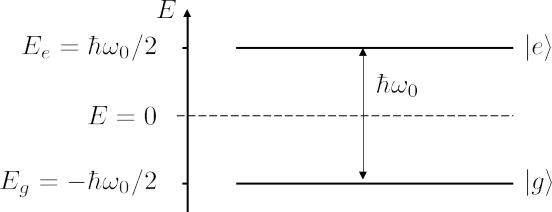
The first term corresponds to a uniform energy offset that does not affect the system’s dynamics. We can therefore redefine the zero of energy such that it lies midway between the two states (see Figure 1), which simplifies the Hamiltonian to
\[ \hat{H}_A = \frac{\hbar\omega_0}{2}\,\hat{\sigma}_z = \frac{\hbar}{2} \begin{pmatrix} \omega_0 & 0 \\ 0 & -\omega_0 \end{pmatrix}, \]
where \(\omega_0 = (E_e - E_g)/\hbar\) is the resonance frequency of the transition.
Summary
- A two-level system is the simplest non-trivial quantum system and serves as a universal model for light–matter interaction, spin dynamics, and qubit physics.
- Any quantum state can be written as a superposition of the ground and excited states, described by time-dependent amplitudes \(c_g(t)\) and \(c_e(t)\).
- The dynamics of such systems can be represented compactly using Pauli matrices, which form a complete operator basis in two dimensions.
- The raising (\(\hat{\sigma}_+\)) and lowering (\(\hat{\sigma}_-\)) operators describe transitions between the two states, while \(\hat{\sigma}_z\) gives the population inversion.
- The atomic Hamiltonian can be written as \(\hat{H}_A = \frac{\hbar\omega_0}{2}\hat{\sigma}_z\), with \(\omega_0\) being the resonance frequency between the two states.
- This formalism provides the foundation for describing coherent driving, Rabi oscillations, and optical Bloch equations, which will be introduced in the next sections.