This chapter introduces the wave-mechanical description of quantum particles. We begin with electron interference because it exposes the central problem directly: electrons are detected as localized particles, but the distribution of many detection events can show interference, a characteristic wave phenomenon.
The specific goals for this chapter are:
Discuss electron interference and the experimental evidence for matter waves.
Review the description of waves, including amplitude, wavelength, frequency, phase, and the complex representation of a wave.
Introduce superposition and interference and show why relative phase determines an interference pattern.
Introduce probability distributions and the Born interpretation of the quantum-mechanical wave function.
Introduce the de Broglie relations between momentum and wave vector and between energy and frequency.
Motivate the Schrödinger equation and its description of the time evolution of a quantum state.
ImportantCore Knowledge — Know
A harmonic plane wave can be written in complex form as
\[
\psi(\vec r,t)
=
A e^{i(\vec k\cdot\vec r-\omega t+\phi)},
\]
with
\[
k=\frac{2\pi}{\lambda},
\qquad
\omega=2\pi f.
\]
Quantum-mechanical amplitudes obey the superposition principle,
\[
\psi=\psi_1+\psi_2,
\]
and the measurable position probability density is given by the Born rule,
electrons are detected at localized positions, while repeated measurements can produce diffraction and interference patterns;
a quantum state is described by a generally complex probability amplitude\(\psi\), while \(|\psi|^2\) gives the probability density;
probability amplitudes add before taking the absolute square, so that interference arises from the cross terms in
\[
|\psi_1+\psi_2|^2;
\]
the amount of interference depends on the relative phase between the contributing amplitudes;
the de Broglie relations connect the wave description \((\omega,\vec k)\) with the particle quantities \((E,\vec p)\);
an ideal plane wave has a precisely defined momentum but is completely delocalized, whereas a localized state must be formed from a superposition of different wave vectors;
the differential forms of the energy and momentum operators can be motivated by their action on plane waves;
the Schrödinger equation is the fundamental dynamical equation of nonrelativistic quantum mechanics; the argument given in this chapter motivates its form but does not derive it from classical mechanics;
an energy eigenstate evolves only by a time-dependent phase factor, so its position probability density is time independent.
The detailed interference derivations, Fourier-transform formulas, and Gaussian wave-packet example are included to develop these ideas, but the intermediate algebra is not intended as material to memorize.
1. Electron Interference and Matter Waves
1.1 What is an electron?
By the beginning of the 20th century, the electron was well established as a constituent of matter with a definite electric charge and mass. These properties naturally suggested a particle-like picture: an electron could be thought of as a small charged particle following a definite trajectory.
In an idealized double-slit experiment, such a classical particle picture suggests that each electron passes through either slit 1 or slit 2. The distribution observed with both slits open should therefore simply be the sum of the distributions obtained from the individual slits,
\[
P_{12}(x)=P_1(x)+P_2(x).
\]
Electrons, however, produce interference patterns. A particularly direct demonstration was provided by Claus Jönsson, who observed electron diffraction and interference from artificially fabricated single and multiple slits in 1961 (Jönsson, 1961).
Figure 1: Simulated build-up of an interference pattern from individual detection events.
The result immediately raises a question:
Why do objects that are detected as particles produce an interference pattern?
The key observation is therefore:
an individual electron is detected at a localized position;
many repeated detections form a wave-like interference pattern.
This behavior cannot be described by a simple classical particle picture or by a simple classical material wave.
1.2 Historical perspective: Electron diffraction
The electron double-slit experiment provides a particularly intuitive illustration of wave-particle behavior. Historically, however, the wave nature of electrons had already been demonstrated in diffraction experiments in the 1920s.
In 1927, Clinton Davisson and Lester Germer scattered electrons from a single crystal of nickel and observed pronounced maxima in the angular distribution of the scattered electrons. These maxima could be explained as electron diffraction by the periodic crystal lattice, in close analogy to the diffraction of x rays by crystals (Davisson & Germer, 1927).
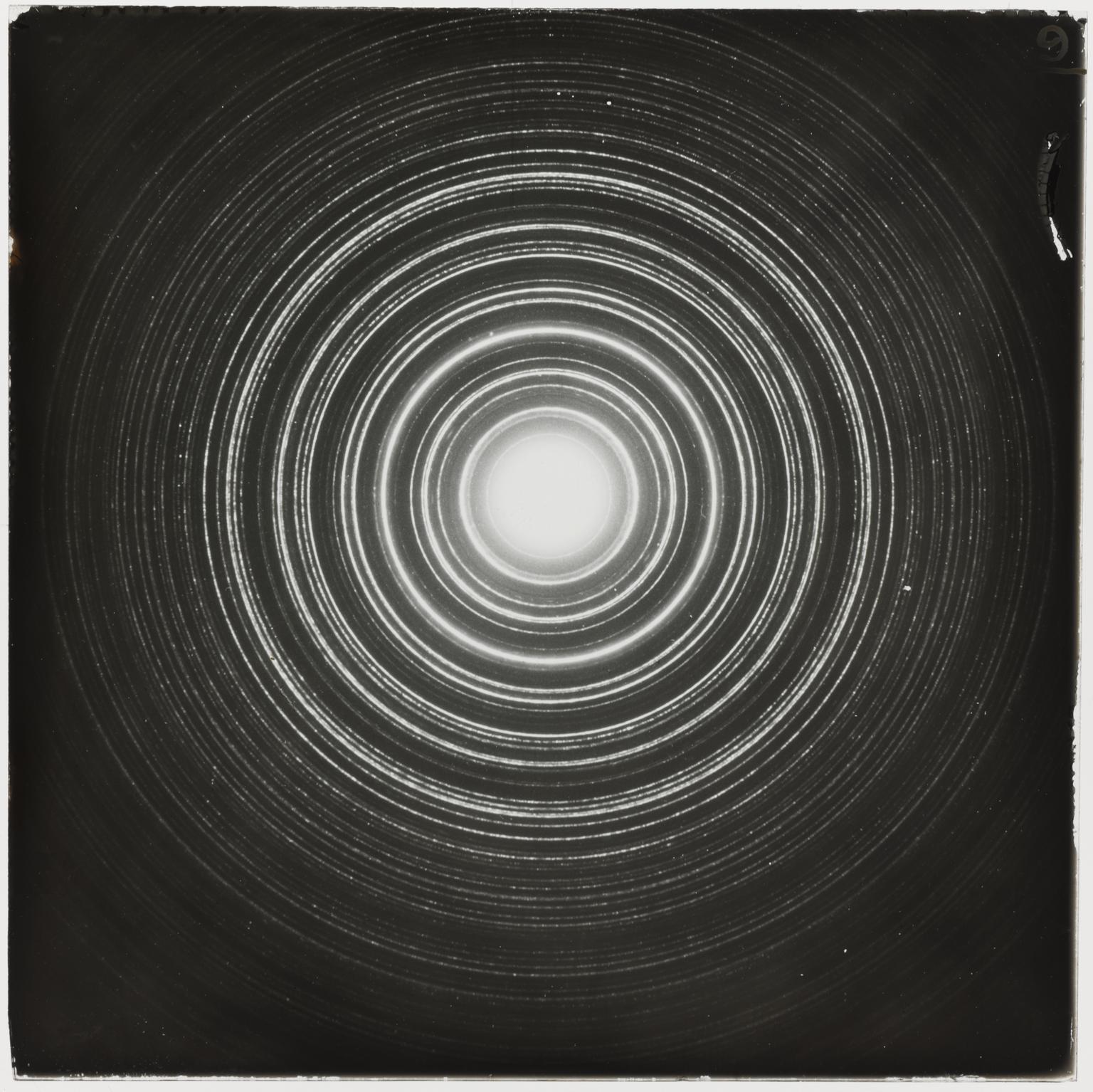
At about the same time, George Paget Thomson investigated electrons transmitted through thin crystalline films. Instead of angular scattering maxima, these experiments produced characteristic diffraction rings on photographic plates. The ring patterns provided another striking demonstration that electrons exhibit wave-like behavior.
Figure 2: Electron diffraction pattern recorded in experiments by George Paget Thomson. The concentric rings result from diffraction of electrons transmitted through a thin crystalline film. Source: Science Museum Group Collection. Licensed under CC BY-NC-SA 4.0.
The two experiments used different geometries but led to the same conclusion: electrons, despite their particle-like properties such as charge and mass, can undergo diffraction. Davisson and Thomson later shared the 1937 Nobel Prize in Physics for the experimental discovery of electron diffraction.
The experiments provided direct evidence that electrons possess a wavelength. We will return to the quantitative relation between wavelength and momentum in Section 5.
NoteHistorical note
George Paget Thomson was the son of J. J. Thomson, whose cathode-ray experiments helped establish the electron as a constituent of matter with particle-like properties. About three decades later, G. P. Thomson’s diffraction experiments provided direct evidence for the electron’s wave-like behavior.
2. Waves and Complex Wave Amplitudes
2.1 A traveling wave
A one-dimensional harmonic traveling wave can be written as
\[
y(x,t)=A\cos\big(kx-\omega t+\phi\big).
\]
It is useful to define the phase of the wave as the complete argument of the trigonometric function,
\[
\theta(x,t)=kx-\omega t+\phi.
\]
Here,
\(A\) is the amplitude,
\(\lambda\) is the wavelength,
\(k=2\pi/\lambda\) is the wave number,
\(f\) is the frequency,
\(\omega=2\pi f\) is the angular frequency,
\(\theta(x,t)\) is the phase of the wave,
\(\phi\) is the phase offset (or initial phase).
Thus, in these notes the word phase refers to the full quantity \(\theta(x,t)\), while \(\phi\) denotes only the constant phase offset.
Figure 3: A harmonic wave at fixed time. The figure illustrates the amplitude A, wavelength λ, and the spatial shift associated with a phase offset φ.
A change in phase offset corresponds to a horizontal shift of the wave. At fixed time,
\[
\Delta x=-\frac{\phi}{k}.
\]
More importantly for interference, two waves need not have the same phase at a given position. Their relative phase will determine whether they interfere constructively or destructively.
The complex representation keeps track of both amplitude and phase and makes the mathematics of superposition particularly simple.
For a classical wave, the complex notation is often only a mathematical convenience and the measurable quantity is obtained from the real part. In quantum mechanics, by contrast, the wave function \(\psi\) is itself generally complex and has a different physical interpretation, which we will introduce in Section 4.
3. Superposition and Interference
For two waves with amplitudes \(A_1\) and \(A_2\),
In a double-slit geometry the phase difference results primarily from the difference in path length,
\[
\Delta\theta=k\,\Delta L
=\frac{2\pi}{\lambda}\Delta L.
\]
For slits separated by \(d\) in the far-field approximation,
\[
\Delta L\simeq d\sin\alpha.
\]
Thus different positions on the observation screen correspond to different relative phases and therefore to alternating constructive and destructive interference.
Double-slit interference. Instantaneous real part of a monochromatic wave propagating through two narrow slits. The waves emerging from the slits overlap and interfere as they propagate.
4. Probability and the Born Rule
4.1 Probability distributions
Before assigning a physical meaning to the quantum-mechanical wave function, we briefly review probability densities.
Let \(p(x)\) be a probability density. The probability of finding a measurement outcome between \(a\) and \(b\) is
Quantum mechanics associates a complex wave function \(\psi(\vec r,t)\) with the state of a particle. According to the Born rule, the probability density for position is
\[
\boxed{p(\vec r,t)=|\psi(\vec r,t)|^2.}
\]
Thus the probability of detecting the particle within a small volume \(d^3r\) is
\[
dP=|\psi(\vec r,t)|^2\,d^3r,
\]
and the probability of finding it in a finite region \(R\) is
The electron-interference experiment can now be expressed very compactly. The probability amplitudes associated with the two alternatives add,
\[
\psi=\psi_1+\psi_2,
\]
but the measurable probability density is
\[
|\psi|^2=|\psi_1+\psi_2|^2,
\]
which contains the interference term.
Note
A plane wave extending over all space is not square-normalizable in the usual sense. It is an idealized state of exactly defined momentum and can be treated using box normalization or the generalized normalization of continuum states.
5. Matter Waves and the de Broglie Relations
The experiments discussed in Section 1 show that particles can exhibit wave-like behavior. de Broglie proposed that the momentum of a particle is related to its wave vector by
\[
\boxed{\vec p=\hbar\vec k}
\]
or equivalently
\[
\boxed{\lambda=\frac{h}{p}.}
\]
The corresponding relation between energy and angular frequency is
\[
\boxed{E=\hbar\omega.}
\]
These relations connect particle quantities \((E,\vec p)\) to wave quantities \((\omega,\vec k)\).
For a one-dimensional plane wave,
\[
\psi(x,t)=A e^{i(kx-\omega t)},
\]
the momentum and energy are therefore
\[
p=\hbar k,
\qquad
E=\hbar\omega.
\]
The probability density of an ideal plane wave is constant,
\[
|\psi(x,t)|^2=|A|^2,
\]
so it is completely delocalized in position. This is consistent with the plane wave representing a state of precisely defined momentum.
5.1 Wave packets and momentum space
A localized particle cannot be represented by a single plane wave. Instead, it is represented by a superposition of plane waves with different wave vectors.
Because \(p=\hbar k\), the distribution in \(k\) is directly related to the distribution of momentum. A narrow range of wave vectors produces an extended wave packet in position, while strong localization requires a broader range of wave vectors. This relation will later lead naturally to the position–momentum uncertainty relation.
These are examples of operators: mathematical objects that act on a wave function. Operators and their general role in quantum mechanics are discussed in the next chapter.
6.2 Potential energy and the Hamiltonian
For a nonrelativistic classical particle,
\[
E=T+V=\frac{p^2}{2m}+V.
\]
Here \(V(\vec r,t)\) is the potential energy that describes the interaction of the particle with its environment. Examples include
\[
V=mgh
\]
for a particle near the surface of the Earth and
\[
V=q\Phi
\]
for a charge \(q\) in an electrostatic potential \(\Phi\).
In atomic physics, the Coulomb interaction between an electron and a nucleus of charge \(+Ze\) gives
\[
V(r)=-\frac{Ze^2}{4\pi\varepsilon_0 r}.
\]
Replacing the classical energy and momentum quantities by the corresponding quantum-mechanical operators motivates
The argument above motivates the form of the Schrödinger equation; it is not a derivation from classical mechanics. Within nonrelativistic quantum mechanics, the Schrödinger equation is a fundamental dynamical law.
Figure 4: Free Gaussian wave packet: the center moves while the position distribution spreads with time. Dimensionless units with ħ=m=1 are used.
The wave packet illustrates several important ideas at once:
a localized state is a superposition of plane waves;
its center moves with the group velocity;
its position distribution can spread with time;
unlike an ideal plane wave, a Gaussian wave packet is square-normalizable.
Additional remarks
Analytic solutions of the Schrödinger equation exist only for a limited number of systems. Approximation methods and numerical solutions are therefore essential in atomic and molecular physics.
The nonrelativistic Schrödinger equation is not sufficient when relativistic effects become important. Relativistic quantum mechanics leads to equations such as the Dirac equation, and a fully quantized treatment of electromagnetic interactions requires quantum electrodynamics.
A scalar spatial wave function is not sufficient to describe all quantum degrees of freedom. Electron spin, for example, requires a two-component spinor structure, which will be introduced later in the course.