Two-Electron States in Helium

Author

Daniel Fischer

1. Spin-Spin Coupling in Helium

Having seen that the helium atom cannot be solved exactly, we now turn our attention to another crucial aspect of multi-electron atoms: the spin states. Even in our approximate treatment, we must account for the fact that electrons have spin, and the way these spins combine has profound consequences for the atom’s properties.

1.1 Two-electron spin states

Each electron has spin \(s_1 = s_2 = \frac{1}{2}\). When we have two electrons, we can form a total spin: \[ \vec{S} = \vec{s}_1 + \vec{s}_2 \]

The natural question is: what values can the total spin quantum number \(S\) take? From our study of angular momentum addition (see chapter on angular momenta), we know that combining two spin-\(\frac{1}{2}\) particles gives: \[ S = 1 \quad \text{or} \quad S = 0 \]

with corresponding magnetic quantum numbers \(M_S = +1, 0\) for \(S=1\) and \(M_S = 0\) for \(S=0\).

1.2 Constructing the spin states

Let’s explicitly construct these states using the notation \(|s_1, m_1\rangle |s_2, m_2\rangle\) or more compactly \(|\uparrow\rangle\) for spin-up and \(|\downarrow\rangle\) for spin-down.

The triplet state (\(S=1\))

For \(S=1\), we have three states (hence “triplet”) corresponding to \(M_S = +1, 0, -1\):

\[ \begin{aligned} |S=1, M_S=1\rangle &= |\uparrow\uparrow\rangle = |\uparrow\rangle_1|\uparrow\rangle_2 \\ |S=1, M_S=0\rangle &= \frac{1}{\sqrt{2}}\left(|\uparrow\downarrow\rangle + |\downarrow\uparrow\rangle\right) \\ |S=1, M_S=-1\rangle &= |\downarrow\downarrow\rangle = |\downarrow\rangle_1|\downarrow\rangle_2 \end{aligned} \]

The \(M_S=0\) state requires special attention. It’s a symmetric combination of the two possible arrangements where one electron is up and the other is down. This state is obtained by applying Clebsch-Gordan coefficients or by using raising/lowering operators on the \(M_S=\pm 1\) states (see the page on Angular Momenta and Their Couplings).

The singlet state (\(S=0\))

For \(S=0\), there is only one state (hence “singlet”) with \(M_S = 0\): \[ |S=0, M_S=0\rangle = \frac{1}{\sqrt{2}}\left(|\uparrow\downarrow\rangle - |\downarrow\uparrow\rangle\right) \]

This is the antisymmetric combination of the two spin arrangements.

ImportantExchange symmetry

Notice that the triplet state with \(M_S=0\) is symmetric under particle exchange: \[ \hat{P}_{12}\,|S=1, M_S=0\rangle = +|S=1, M_S=0\rangle \]

while the singlet state is antisymmetric: \[ \hat{P}_{12}\,|S=0, M_S=0\rangle = -|S=0, M_S=0\rangle \]

where \(\hat{P}_{12}\) is the permutation operator that exchanges particles 1 and 2. This exchange symmetry property is crucial for understanding the connection to the spatial wave function and the Pauli exclusion principle.

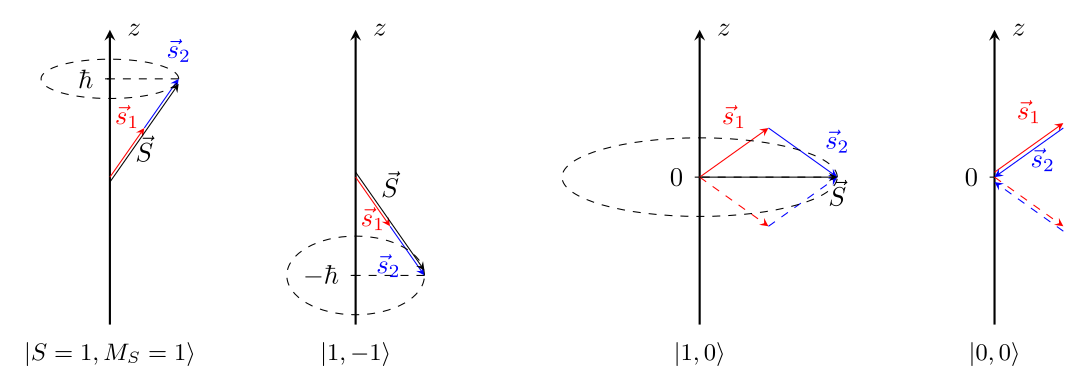
1.3 Graphical representation

It’s helpful to visualize these spin states:

  • Triplet states (\(S=1\), total spin 1):
    • \(|\uparrow\uparrow\rangle\): Both spins pointing up along the \(z\)-axis
    • \(\frac{1}{\sqrt{2}}(|\uparrow\downarrow\rangle + |\downarrow\uparrow\rangle)\): One spin up, one down (superposition)
    • \(|\downarrow\downarrow\rangle\): Both spins pointing down
  • Singlet state (\(S=0\), total spin 0):
    • \(\frac{1}{\sqrt{2}}(|\uparrow\downarrow\rangle - |\downarrow\uparrow\rangle)\): One up, one down (antisymmetric combination)

The key distinction is in the relative phase between \(|\uparrow\downarrow\rangle\) and \(|\downarrow\uparrow\rangle\) components.

Coupling of two electron spins.

NoteEntangled states

The states \(|10\rangle\) and \(|00\rangle\) are entangled states. The orientation of the individual spins is undetermined, but their relative orientation is determined. The measurement of one spin “fixes” the other. This is the famous Einstein-Podolsky-Rosen (EPR) paradox applied to spin states.

1.4 Connection to the spatial wave function

Now comes a crucial question that connects spin to the chemistry and spectroscopy of helium:

Is the ground state of helium a singlet or triplet state?

The answer depends on the symmetry of the spatial wave function. Recall that the spatial wave function for the ground state is: \[ \Psi_{100}(\vec{r}_1, \vec{r}_2) = \frac{8}{\pi a_0^3} e^{-2(r_1 + r_2)/a_0} \]

This spatial wave function has even exchange symmetry, meaning: \[ \Psi_{100}(\vec{r}_1, \vec{r}_2) = \Psi_{100}(\vec{r}_2, \vec{r}_1) \]

Since electrons are fermions, the total wave function must be antisymmetric under particle exchange. If the spatial part is symmetric, the spin part must be antisymmetric: \[ \Psi_{\text{total}} = \Psi_{100}(\vec{r}_1, \vec{r}_2) \times \chi(1,2) \]

where \(\chi(1,2)\) is the spin wave function. For the total wave function to be antisymmetric: \[ \chi(1,2) = \frac{1}{\sqrt{2}}\left(|\uparrow\downarrow\rangle - |\downarrow\uparrow\rangle\right) = -\chi(2,1) \]

Therefore, the ground state is a singlet state (\(S=0\)).

1.5 Excited states

For excited states, things become more interesting. Consider the first excited configuration where one electron is in the \(n=1\) state and the other in the \(n=2\) state. The spatial wave function can now be either:

  • Symmetric: \(\Psi_S = \frac{1}{\sqrt{2}}(\psi_{100}(\vec{r}_1)\psi_{200}(\vec{r}_2) + \psi_{200}(\vec{r}_1)\psi_{100}(\vec{r}_2))\)
  • Antisymmetric: \(\Psi_A = \frac{1}{\sqrt{2}}(\psi_{100}(\vec{r}_1)\psi_{200}(\vec{r}_2) - \psi_{200}(\vec{r}_1)\psi_{100}(\vec{r}_2))\)

Because symmetric and antisymmetric spatial wave functions can be constructed, excited states can have both singlet and triplet configurations. The Pauli principle determines which spin state must accompany which spatial state:

  • Symmetric spatial → Antisymmetric spin (Singlet, \(S=0\), parahelium)
  • Antisymmetric spatial → Symmetric spin (Triplet, \(S=1\), orthohelium)
TipNomenclature

Historically, the singlet and triplet states of helium were thought to be different elements:
- Parahelium: Singlet states (\(S=0\)), spin-paired
- Orthohelium: Triplet states (\(S=1\)), spins parallel

Transitions between singlet and triplet states are forbidden (spin-changing transitions are very weak), so these behave almost like separate atomic systems.

This spin-statistics connection has profound implications for atomic spectra, chemical bonding, and our understanding of quantum statistics. The helium atom thus serves as the simplest laboratory for studying these fundamental quantum mechanical principles.

2. Dipole Selection Rules and Ortho–Parahelium

The spin and spatial symmetries of the two-electron wave functions in helium have direct consequences for which transitions are allowed in the spectrum. To understand the observed spectral lines, we must recall the electric dipole selection rules, which govern spontaneous and stimulated transitions between atomic states.

2.1 Electric Dipole Selection Rules

In the electric dipole approximation, a transition between two states \(\psi_i\) and \(\psi_f\) is allowed only if the electric dipole matrix element is nonzero:

\[ \langle \psi_f | \hat{\vec{r}} | \psi_i \rangle \neq 0 \]

The corresponding selection rules arise from the symmetries of the angular and spin wave functions:

  • Change of orbital angular momentum:
    \[\Delta \ell = \pm 1\] (because the dipole operator \(\vec{r}\) has odd parity)

  • Change of total spin:
    \[\Delta S = 0\]
    (the dipole operator does not act on spin)

  • Change of magnetic quantum number:
    \[\Delta m_\ell = 0, \pm 1\]

The rule \(\Delta S = 0\) is particularly important in helium:
it means that electric dipole transitions cannot change the total spin.
As a result, singlet and triplet states form two largely independent systems.

As mentioned above, these two “spin systems” are called:

  • Parahelium – singlet states (\(S = 0\))
  • Orthohelium – triplet states (\(S = 1\))

Transitions between para- and orthohelium are spin-forbidden, and hence extremely weak. In a Grotrian diagram (see figure below, these correspond to two separate ladders of energy levels, connected only by very weak intercombination lines.


2.2 Spectroscopic Series and the Helium Grotrian Diagram

In analogy with hydrogen, helium’s excited states form spectral series such as \(1s\,n s\), \(1s\,n p\), \(1s\,n d\), etc.
However, each configuration now occurs in both singlet and triplet form, labeled as \({}^{2S+1}L_J\).
For example:

Configuration Term Symbol Common Name
\(1s^2\) \({}^1S_0\) Ground state (parahelium)
\(1s2s\) \({}^1S_0\), \({}^3S_1\) Metastable singlet and triplet states
\(1s2p\) \({}^1P_1\), \({}^3P_{0,1,2}\) Dipole-coupled excited states

In the Grotrian diagram, allowed electric dipole transitions connect levels according to the rules above. Thus, \({}^1P_1 \leftrightarrow {}^1S_0\) is allowed (ΔS = 0, Δℓ = ±1), while \({}^3P_1 \to {}^1S_0\) is strongly suppressed (ΔS ≠ 0).

Code
import matplotlib.pyplot as plt
import numpy as np
from matplotlib.patches import Rectangle


plt.rcParams['text.usetex'] = True
plt.rcParams['font.family'] = 'serif'
plt.rcParams['font.size'] = 10


# Energy levels (relative to the continuum at 0 eV) and their positions on the y-axis
# We use a dictionary to store the energy levels for easy lookup.
energy_levels_singlet = {
    '1S': -6.587,  # this is shifted by 18 eV for visibility
    '2S': -3.97,
    '2P': -3.37,
    '3S': -1.67,
    '3P': -1.5,
    '3D': -1.51,
    '4S': -0.913,
    '4P': -0.845,
    '4D': -0.851,
    '4F': -0.850,
    '5S': -0.576,
    '5P': -0.541,
    '5D': -0.544,
    '5F': -0.544,
}
energy_levels_triplet = {
    '2S': -4.769,
    '2P': -3.62,
    '3S': -1.67,
    '3P': -1.58,
    '3D': -1.51,
    '4S': -0.993,
    '4P': -0.879,
    '4D': -0.851,
    '4F': -0.850,
    '5S': -0.615,
    '5P': -0.559,
    '5D': -0.544,
    '5F': -0.544,
}


# x-coordinates for each term (S, P, D, F) to create columns
# Values are chosen to create a visual separation similar to the Grotrian diagram.
x_positions_singlet = {
    'S': 0.5,
    'P': 1.5,
    'D': 2.5,
    'F': 3.5
}

x_positions_triplet = {
    'S': 5,
    'P': 6,
    'D': 7,
    'F': 8
}

# --- Set up the plot ---
fig, ax = plt.subplots(figsize=(7, 5))
ax.set_ylim(-8, 1)
ax.set_xlim(0, 10.5)

# Hide the x-axis ticks and labels as we are creating custom annotations
y_tick_locations = [i for i in range(-8, 1)]
y_tick_labels = ['-26','-25','-24','-5','-4','-3','-2','-1','0']

ax.set_yticks(y_tick_locations)
ax.set_yticklabels(y_tick_labels)
ax.set_ylabel('energy (eV)')
ax.set_xticks([])
ax.spines['top'].set_visible(False)
ax.spines['right'].set_visible(False)
ax.spines['bottom'].set_visible(False)


# --- Plot the energy level lines and labels ---
line_length = 0.4


for term in energy_levels_singlet:
    key = term.strip('12345')
    n = int(term.strip('SPDF'))
    x=x_positions_singlet[key]
    j=int(x-0.5)
    ax.hlines(energy_levels_singlet[term], x - line_length, x + line_length, color='black', linewidth=2)
    if (n < 4):
        ax.text(x, energy_levels_singlet[term] - 0.1, f'${n} ^1{key}_{j}$', ha='center', va='top')

for term in energy_levels_triplet:
    key = term.strip('12345')
    n = int(term.strip('SPDF'))
    x=x_positions_triplet[key]
    j=int(x-4)
    ax.hlines(energy_levels_triplet[term], x - line_length, x + line_length, color='black', linewidth=2)
    if (n < 4):
        if (key == 'S'):
            ax.text(x, energy_levels_triplet[term] - 0.1, f'${n} ^3{key}_{j}$', ha='center', va='top')
        else:
            ax.text(x, energy_levels_triplet[term] - 0.1, f'${n}^3{key}_{{{j-2},{j-1},{j}}}$', ha='center', va='top')
    

# Custom labels for the columns and energy values
ax.text(2, 0.5, 'singlet', ha='center', va='center', fontsize=11)
ax.text(6.5, 0.5, 'triplet', ha='center', va='center', fontsize=11)

# Custom lines and labels for n=5, 4, 3, 2
#for n, y in [(5, energy_levels['5S']), (4, energy_levels['4S']), (3, energy_levels['3S']), (2, energy_levels['2S'])]:
for n in range(2,6):
    y = - 13.6 / n**2
    ax.text(9.5, y, f'$n={n}$', ha='left', va='center')
    ax.hlines(y, 0, 9, color='black', ls=':', linewidth=0.3)


# He+ + e- continuum
ax.hlines(0, 0, 9, color='black', linewidth=1.5)
ax.fill_between(np.linspace(0, 9, 100), 0, 1, color='lightgrey', hatch='///', alpha=0.5)
ax.text(4.5, 0.2, r'He$^+ + e^{-}$', ha='center', va='bottom', fontsize=11)

# Hydrogen and custom boxes
ax.text(9.7, 0.5, 'H', ha='center', va='center', fontsize=11)
ax.hlines(0, 9.2, 10.2, color='black', linewidth=1.5)
ax.fill_between(np.linspace(9.2, 10.2, 10), 0, 1, color='lightgrey', hatch='///', alpha=0.5)


# --- Add the fake break here ---
# Coordinates for the rectangle to hide the middle section
break_y_min = -5.6
break_y_max = -5.4
#break_x_min = -0.1 # x position of left spine
#break_x_max = 0.3 # Width of the break patch, set slightly larger than the spine

# Add a white rectangle to hide the axis spine in the break region
#rect = Rectangle((break_x_min, break_y_min), break_x_max, break_y_max - break_y_min,
#                 facecolor='white', edgecolor='white', zorder=3, transform=ax.transData)
#ax.add_patch(rect)
ax.spines['left'].set_visible(False)
ax.vlines(0,ax.get_ylim()[0], break_y_min, color='black', linewidth=1)
ax.vlines(0,ax.get_ylim()[1], break_y_max, color='black', linewidth=1)


# Add the break symbol "//"
ax.text(0, (break_y_min + break_y_max) / 2+0.03, r'$//$',
        ha='center', va='center', fontsize=14, color='black', rotation=90)


# --- Plot the transitions (red arrows) ---
# Format: (start_x, start_y), (end_x, end_y)
transitions = [
    # Singlet transitions
    (x_positions_singlet['P'], energy_levels_singlet['2P'], x_positions_singlet['S'], energy_levels_singlet['1S']),
    (x_positions_singlet['P'], energy_levels_singlet['3P'], x_positions_singlet['S'], energy_levels_singlet['2S']),
    (x_positions_singlet['P'], energy_levels_singlet['2P'], x_positions_singlet['S'], energy_levels_singlet['2S']),
    (x_positions_singlet['P'], energy_levels_singlet['4P'], x_positions_singlet['S'], energy_levels_singlet['2S']),
    (x_positions_singlet['P'], energy_levels_singlet['4P'], x_positions_singlet['S'], energy_levels_singlet['3S']),
    (x_positions_singlet['S'], energy_levels_singlet['3S'], x_positions_singlet['P'], energy_levels_singlet['2P']),
    (x_positions_singlet['S'], energy_levels_singlet['4S'], x_positions_singlet['P'], energy_levels_singlet['2P']),
    (x_positions_singlet['S'], energy_levels_singlet['4S'], x_positions_singlet['P'], energy_levels_singlet['3P']),
    (x_positions_singlet['D'], energy_levels_singlet['3D'], x_positions_singlet['P'], energy_levels_singlet['2P']),
    (x_positions_singlet['D'], energy_levels_singlet['4D'], x_positions_singlet['P'], energy_levels_singlet['3P']),
    (x_positions_singlet['P'], energy_levels_singlet['4P'], x_positions_singlet['D'], energy_levels_singlet['3D']),
    (x_positions_singlet['F'], energy_levels_singlet['4F'], x_positions_singlet['D'], energy_levels_singlet['3D']),
    (x_positions_singlet['P'], energy_levels_singlet['3P'], x_positions_singlet['S'], energy_levels_singlet['1S']),
    # Triplet transitions
    (x_positions_triplet['P'], energy_levels_triplet['3P'], x_positions_triplet['S'], energy_levels_triplet['2S']),
    (x_positions_triplet['P'], energy_levels_triplet['2P'], x_positions_triplet['S'], energy_levels_triplet['2S']),
    (x_positions_triplet['P'], energy_levels_triplet['4P'], x_positions_triplet['S'], energy_levels_triplet['2S']),
    (x_positions_triplet['P'], energy_levels_triplet['4P'], x_positions_triplet['S'], energy_levels_triplet['3S']),
    (x_positions_triplet['S'], energy_levels_triplet['3S'], x_positions_triplet['P'], energy_levels_triplet['2P']),
    (x_positions_triplet['S'], energy_levels_triplet['4S'], x_positions_triplet['P'], energy_levels_triplet['2P']),
    (x_positions_triplet['S'], energy_levels_triplet['4S'], x_positions_triplet['P'], energy_levels_triplet['3P']),
    (x_positions_triplet['D'], energy_levels_triplet['3D'], x_positions_triplet['P'], energy_levels_triplet['2P']),
    (x_positions_triplet['D'], energy_levels_triplet['4D'], x_positions_triplet['P'], energy_levels_triplet['3P']),
    (x_positions_triplet['P'], energy_levels_triplet['4P'], x_positions_triplet['D'], energy_levels_triplet['3D']),
    (x_positions_triplet['F'], energy_levels_triplet['4F'], x_positions_triplet['D'], energy_levels_triplet['3D']),

]

for x1, y1, x2, y2 in transitions:
    ax.annotate("", xy=(x2, y2), xytext=(x1, y1),
                arrowprops=dict(arrowstyle="->", color='red', lw=1.5), zorder=0)

plt.tight_layout()
plt.show()
Simplified Grotrian diagram for helium, showing some dipole-allowed transitions within the singlet (parahelium) and triplet (orthohelium) systems. Cross-system transitions are spin-forbidden.

Simplified Grotrian diagram for helium, showing some dipole-allowed transitions within the singlet (parahelium) and triplet (orthohelium) systems. Cross-system transitions are spin-forbidden.

2.3 Metastable States and Lifetimes

Because triplet–singlet transitions are forbidden, the lowest triplet state
\[1s2s\,{}^3S_1\]
cannot decay efficiently to the singlet ground state \(1s^2\,{}^1S_0\).
Its decay must proceed through magnetic dipole (M1) or two-photon processes, both of which are extremely slow.
This makes \(1s2s\,{}^3S_1\) one of the most metastable states known in atomic physics.

Measured lifetimes:

State Dominant decay mechanism Typical lifetime
\(1s2s\,{}^1S_0\) Two-photon decay → \(1s^2\,{}^1S_0\) ≈ 19.7 ms
\(1s2s\,{}^3S_1\) Magnetic dipole (M1) decay → \(1s^2\,{}^1S_0\) ≈ 7900 s (≈ 2.2 h)

These long lifetimes make metastable helium (\(\mathrm{He}^*\)) an ideal system for
laser cooling, precision spectroscopy, and cold collision experiments.


2.4 Summary of Selection-Rule Implications

  • Dipole transitions obey \(\Delta \ell = \pm 1\) and \(\Delta S = 0\).
  • The singlet and triplet systems are nearly independent, forming parahelium and orthohelium series.
  • Spin-forbidden transitions give rise to long-lived metastable states,
    especially the \(1s2s\,{}^3S_1\) triplet state.
  • Experimental helium spectra thus show two distinct sets of lines,
    each following hydrogenic-like selection rules, but separated by spin symmetry.